
from red herald
Lyon: Following the Example of Seine-Saint-Denis, Youth Are Rising Up in High Schools
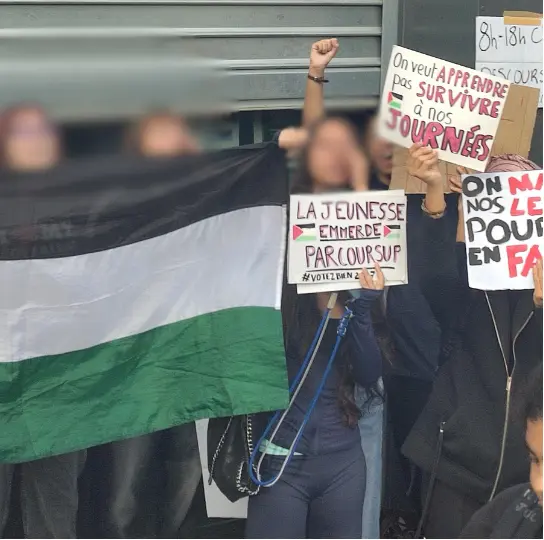
In high schools as well as on college campuses, the demands focus on the practical conditions for studying and living, access to education, and the future of young people. A major movement for dignity is on the horizon, and Lyon is no exception. On Tuesday, September 29, several thousand people demonstrated in Lyon at the call of various sectors of the public services. Starting in the morning, college and high school students mobilized at several institutions, with demands focusing on study and living conditions, the shortage of teachers, and overcrowded classrooms.
The mobilization began early. As early as 6 a.m., a blockade was set up on the Porte des Alpes campus of the University of Lyon 2. In protest against the racist “Bienvenue en France” (“Welcome to France”) law and budget cuts, and in support of striking workers, the mobilized students successfully blockaded the various entrances to the campus, leading to its closure for the day.
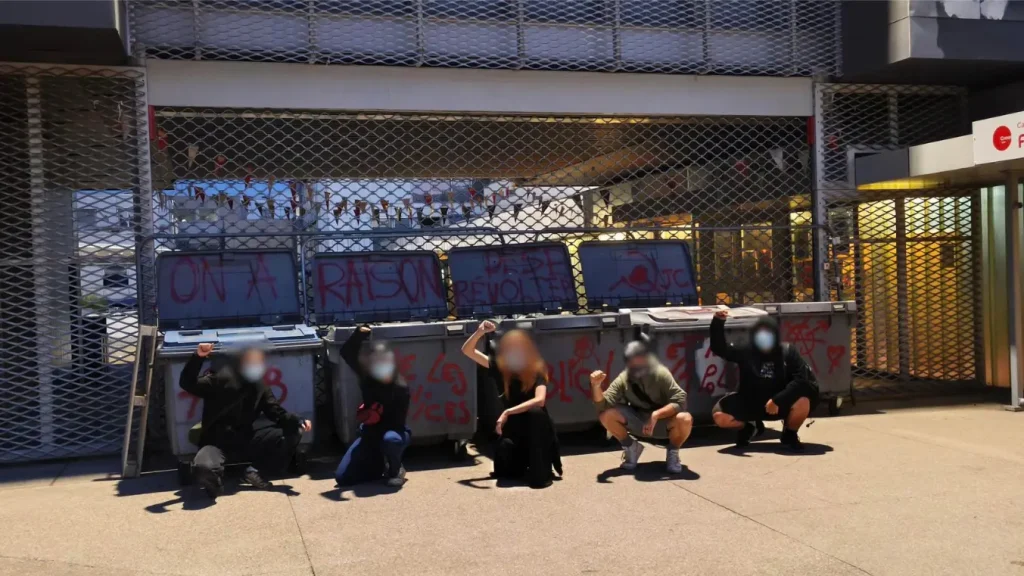
In high schools, the movement also spread, following the mobilization of high school students in Île-de-France, who had already been setting an example for several days. About fifteen schools in Lyon, Vénissieux, and Villeurbanne were affected by the blockades, including the high schools Saint-Exupéry, La Martinière-Diderot, La Martinière Duchère, Auguste and Louis Lumière, Mérieux, La Martinière Monplaisir, Saint-Just, Jean Perrin, Récamier, Condorcet, Blaise Pascal, Jean-Paul Sartre, and Jacques Brel in Vénissieux, as well as Brossolette and Frédéric Fays in Villeurbanne.
“Money for high schools, not for war”
Through these blockades, high school students are putting forward several demands. In particular, they are denouncing overcrowded classrooms, a shortage of teachers, and deteriorating learning conditions. They also highlight the poor condition of certain buildings and educational materials, as well as overly heavy and poorly designed class schedules.
The issue of selection in higher education and the Parcoursup admissions system is also among the main demands: how can one secure a dignified future when the right to education is no longer even accessible?
At Lycée Lumière, high school students and the Communist Youth were mobilized and chanted slogans condemning the war economy being prepared at the expense of the education of the working-class youth, as well as anti-imperialist slogans and those in support of Palestine. Chants in support of the Yellow Vests were also heard. Among the slogans repeated during the protest: “Money for high schools, not for war.”
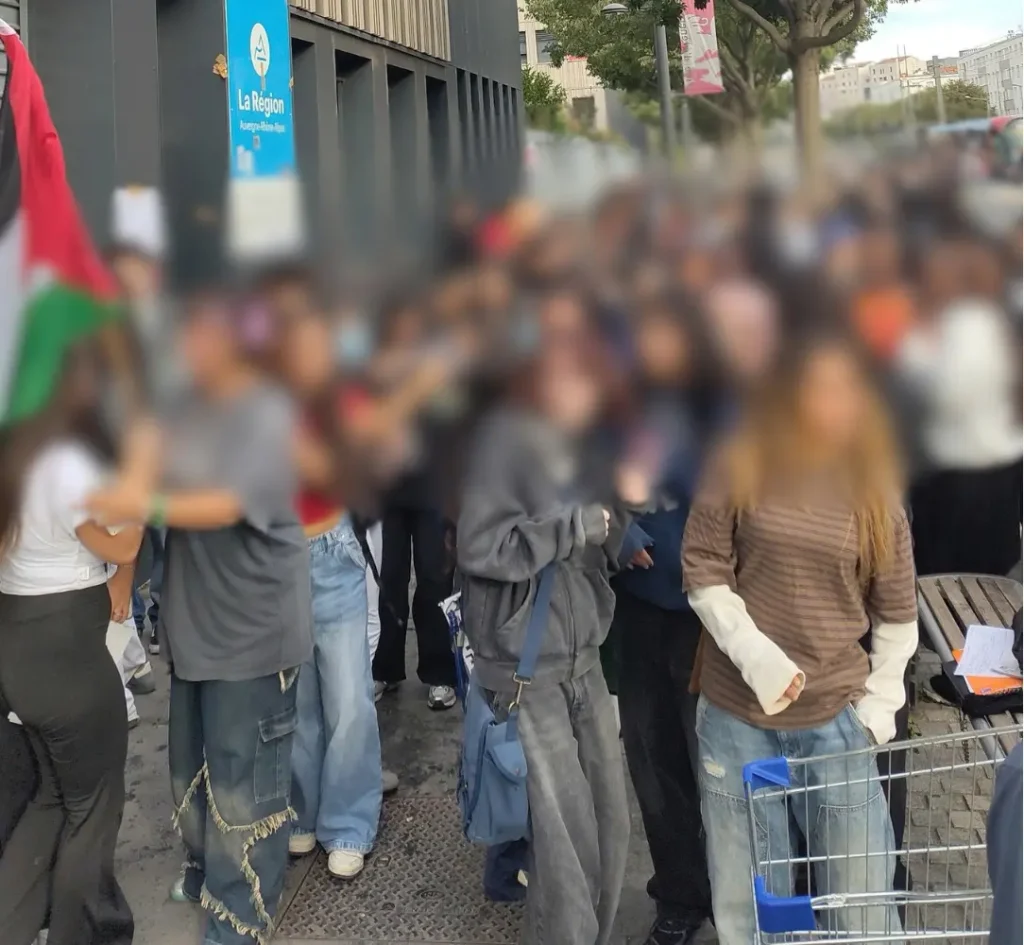
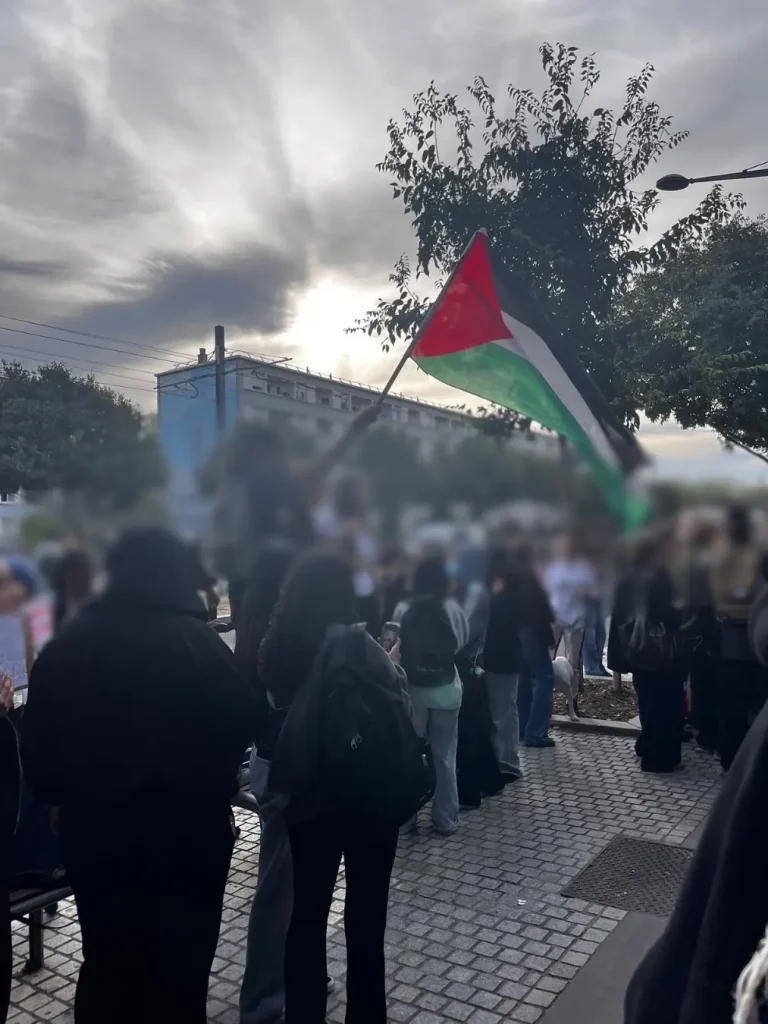
The morning was also marked by a heavy police presence at nearly all high schools, particularly those in working-class neighborhoods. In Vénissieux, as well as near the Lycée Lumière in Lyon’s 8th arrondissement and the Lycée Brossolette in Villeurbanne, participating high school students reported police charges and the use of tear gas; in Vénissieux, they also reported violent arrests of young working-class protesters. By the end of the day, 75 high school students had been arrested for participating in the protests. During the protests, a rally in support of those arrested was organized in front of the central police station in Lyon 8.
Despite this heavy-handed repression, the determination of the working-class youth remained unwavering, and many roadblocks remained in place for much of the morning. The movement is also becoming more combative. By the end of the day, it was in Vaulx-en-Velin that high school students set fire to the door of a police station. At Jacques Brel High School, hundreds of students gathered facing a legion of CRS riot police, several of whom displayed ferocious brutality. As has been the case throughout France, we saw examples of “brave” police officers viciously attacking a young girl by smashing her head against the glass of a tram stop—all while the opportunistic LFI (La France Insoumise) mayor, Idir Boumertit, looked on and, predictably, called for calm.
High school students, college students, and workers take to the streets
At 10:30 a.m., the mobilized youth joined striking workers at the Manufacture des Tabacs, the starting point of the demonstration called by several sectors of the public service.
TCL transit, firefighters, CROUS, and other public services were among the sectors called to strike. The demonstrators marched in particular to demand higher wages and to protest the high cost of living and fuel prices. Around 8,000 people were counted in the streets of Lyon.
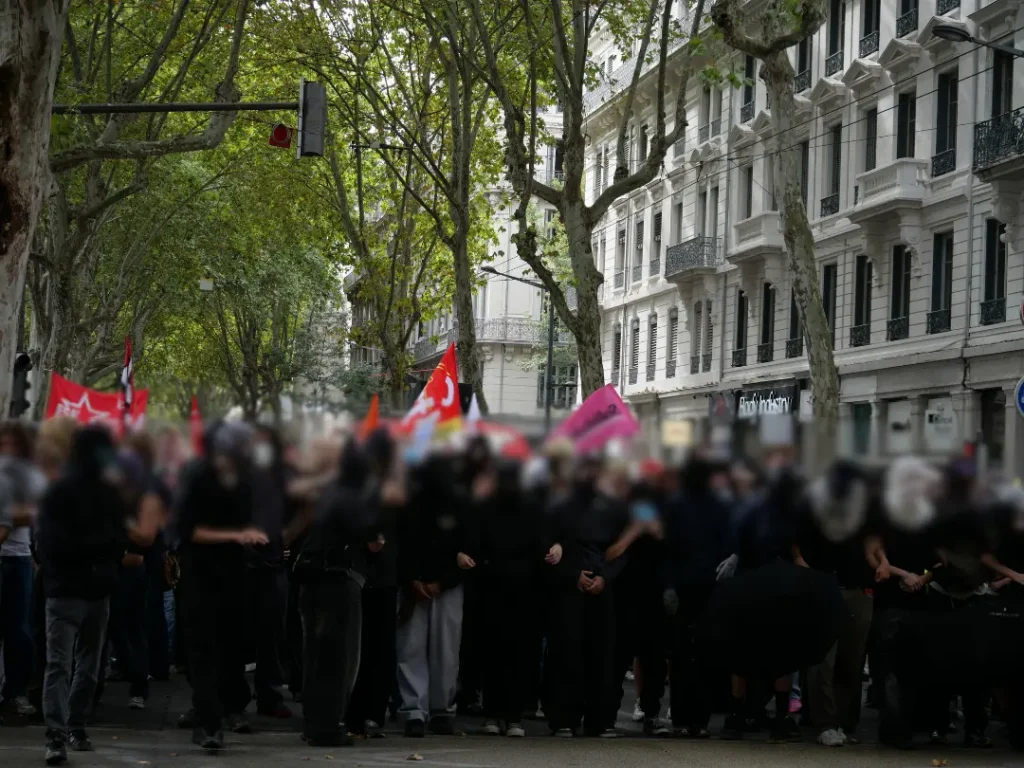
High School Students’ Protest: In Créteil, Saint-Denis, Sarcelles, and Saint-Ouen l’Aumône: We’re Not Dogs!
Since last week, blockades have been multiplying in high schools across the Créteil school district. Starting at a high school in Créteil and quickly joined by about ten schools in Saint-Ouen, Saint-Denis, Stains, and Sarcelles, the student movement has now taken on a national scale, spreading to Grenoble and Nice on Monday, then to Marseille, Lyon, Rennes, Lille, and Toulouse starting Tuesday. On Tuesday, the 29th, alone—according to the Ministry of Education itself—338 schools were involved in the protests, resulting in at least 40 arrests nationwide. In reality, as many as 400 schools are currently blocked, mainly by working-class youth.
The common thread uniting all these protests today is the lack of resources in education and the shortage of staff (class sizes have risen from an average of 27 students per class in 2010 to 30 today, whereas this figure had remained stable for nearly 40 years, and 10% of class hours were not covered during the 2024–2025 school year nationwide). Yet, in 2026, government spending increased by more than 10 billion euros; however, as the Draft Finance Bill (PLF) specifies, “Excluding defense spending, ministerial appropriations are decreasing overall in value.” In other words: less money for public services and for young people, more for the military. We’re starting to hear this same old tune.
There is, however, a twofold aspect to this diversion of resources from education to the military. On the one hand, funding for schools is being cut; students are being deprived of teachers, teachers of decent working conditions, and the entire school community of decent buildings in which to hold classes, funding for activities and field trips, and social assistance to mitigate inequalities among students from different socioeconomic backgrounds. The ideological smokescreen of the “School of the Republic” is dissipating; the social-democratic illusions of equal opportunity and the meritocratic consensus on which liberal ideology has been based since the Bourgeois Revolution no longer inspire much hope in anyone. And the market economy, in any case, no longer allows for it in this day and age: France no longer needs, for the time being, intellectuals and the petty bourgeoisie as much as it needs workers capable of ensuring its industrial sovereignty, as the MEDEF regularly points out. The latest whims of employers are forcing a transformation in the productive forces, and it is this pattern that guides the state’s decisions, for the state is neither neutral nor at the service of the masses, much less a guarantor of “values” shared by citizens; it is merely the executor of the bourgeoisie’s interests. All of this is carried out with a transparency that borders on cynicism. Who, today, still claims that school should focus less on “preparing students for the workforce” and more on helping our children flourish? The social ladder has broken down, and the generation that is blocking its sacrosanct schools this week—temples of knowledge, supposedly the only keys to their emancipation—knows full well that it will have a lower standard of living than the previous generation.
On the other hand, schools must still fulfill one of their core missions—one that has remained unchanged since education was made compulsory in the aftermath of the defeat by the Prussians and the Paris Commune, barely a few decades before World War I, at a time when a third of the population did not even speak French on a daily basis, but when emerging monopolistic corporations needed to secure their share of the globe and thus conquer new market shares. This mission is to unify the nation—that is, to corporatize society, to promote collaboration between the classes, and to ensure that all strata of society embrace the worldview and ideology of the bourgeoisie. In his letter addressed to elementary school teachers on March 28, 1882, the colonialist Jules Ferry wrote by way of introduction: “Of the various obligations it imposes on you, the one that is surely closest to your heart—the one that brings you the heaviest burden of extra work and worry—is the mission entrusted to you to provide your students with moral education and civic instruction.”
Today, we see in the curricula of the INSPE—the school that trains future teachers—and amid the incessant reforms of the CAPES and CRPE, an ever-increasing emphasis on courses on the “values of the Republic,” and an ever-decreasing emphasis on scientific and disciplinary instruction. In schools, this means an intensification of authority—reactionary authority—that is, not the submission of the individual to the collective, but of the collective to a few individuals representing the wealthy minority.
This is the logic behind the ban on the abaya in 2023, the ban on cell phones at the start of the 2026 school year, the increasingly common bans on head coverings in school outdoor areas (i.e., no caps allowed in 40° heat, no hoods during thunderstorms), Crocs, and shorts/bermuda shorts, as well as extended school days—particularly in schools in working-class neighborhoods… Whether one considers them fair or arbitrary, these measures are not designed with the children’s best interests in mind, but rather to reinforce blind discipline—a trend that goes hand in hand with the ever-increasing involvement of the military and police in high schools to suppress dissent or spread their propaganda, as well as at career guidance forums, and the development of measures such as the SNV and the SNU. For how could the working-class youth agree to sacrifice their future—by accepting dangerous, exhausting, and underpaid manual labor, or by enlisting in the military—for a system that has been bled dry by crises and has nothing left to offer in return, not even an education worthy of the name?
This is where, in particular, the recent spate of police violence comes into play—aimed at terrorizing working-class youth (massive use of tear gas, collective beatings in Bordeaux, blows dealt by CRS officers in Grenoble, a high school girl being slapped after being dragged away at the Suger High School in Saint-Denis, and stomach-slams throughout the Île-de-France region…). At the Paul Eluard High School in Saint-Denis, a high school girl exclaims in exasperation: “It doesn’t feel like we’re a class—it feels like we’re on a farm!” Another adds, “We’re kids; we shouldn’t be attacked.” But despite the intimidation everywhere, young people agree that the time for discussion is over—it’s now time for struggle and building a balance of power—and that negotiations have led nowhere for far too long. The old state is trembling; it brandishes the whip in its hand because it has no more carrots to dangle.
From the very first attempts—some more successful than others—to stage blockades in Seine-Saint-Denis, particularly at the ENNA high school, the issue of authority was central; it was the first demand raised by the students themselves. At this vocational high school in Saint-Denis—which hadn’t been blockaded since 2014—students have been calling for mobilization on Snapchat for a week, initially to confront the police, assert their power against a school discipline committee deemed unfair and racist teachers, and protest dress code restrictions, then, for the past few days, for greater gender diversity in the programs (the school has a very high proportion of male students due to the industrial training programs offered there), for more staff (particularly a social worker and a nurse), and for more equipment for hands-on labs and a larger budget. From the very first day of the blockade, students have been holding up a banner facing the administration and the national authorities: “We’re not dogs! .”
At ENNA, as at Bartholdi, Suger, and in most of the mobilized high schools in the 93 and 95 departments, rather than simply closing the gates, the students have a plan: to demonstrate their strength and determination to the administration and the police—and this is achieved primarily through mortar fire and other riot tactics. This level of mobilization surpasses that of other protesting high schools in metropolitan centers across France, where the more ritualized blockade tactic does not necessarily reflect a willingness to go on the offensive against the police and other state representatives—though it does not protect them from police pressure tactics and abuses. But the level of militancy at REP, REP+, vocational, and suburban high schools demonstrates the students’ greater ability to expose the true nature of the state, and stems directly from the conditions at these schools, where authority is even stronger, resources even scarcer, and the future promised to young people even bleaker.
At Paris 8 University, the main university in the 93rd department, nearly 2,000 applications from students who did not gain admission to college—the vast majority of whom came from high schools in the Île-de-France region—were submitted during the first ten days of September, demonstrating the damage caused by Parcoursup, which hits former high school students from the Paris suburbs particularly hard. Young people are witnessing this blatant policy of social selection. A high school student from Utrillo in Stains writes in a poem titled “Justice!” that she sent to our editorial staff: “The inequality among high school students based on where they live in our country continues to grow.” At Utrillo, the mobilization began in early September around the widespread demand to remove a pedophile and racist teacher, who has been singled out by his students and courageous colleagues for nearly 15 years without any disciplinary or legal action being taken against him. The school district is determined not to side with the students and their parents—residents of Stains or Pierrefitte—in the face of a criminal who, whether they like it or not, very well represents reactionary interests. In any case, what does the National Education System do when a teacher turns out to be a pedophile? Very often, it prefers to sideline him rather than fire him, because firing him would mean believing the students a little too firmly and undermining its authority and its keen sense of arbitrariness.
This “don’t rock the boat” policy—which, incidentally, humiliates students and their parents—attempts to sweep the issue of power in schools under the rug, thereby preventing the public, especially the working class, from demanding a say in what happens to their children’s lives. But then again, what other “closet” does the national education system have at its disposal besides the Créteil school district? Deep down, it’s always preferable for the ministry if a teacher abuses children from the suburbs rather than from downtown areas. There’s a much smaller chance that the father is a lawyer or the mother a journalist.
Two days ago, in Saint-Ouen-l’Aumone (95), in front of the Château l’Epluche vocational high school in a REP zone, a 14-year-old student had his teeth and jaw shattered by a grenade fired point-blank into his face by a CRS officer, while in front of the posh Simone Weil high school in Paris’s third arrondissement, the police officers deployed at the blockade were doing push-up contests with the students in a friendly atmosphere. Although in both cases the students are right to protest and their demands are just, it’s clear that the form the protests take differs and does not affect the state in the same way. If, as reported in Bernard Arnaud’s rag—also known as *Le Parisien*—last Thursday, at the blockade of the REP Auguste Blanqui high school in Saint-Ouen, “it feels like Baghdad,” it is precisely because in the suburbs, the mobilized working-class youth do not merely pile trash cans in front of the gate. They go head-to-head with the police, pushing them back, dispersing them, targeting them, firing mortars, and taking risks to weaken those they have designated as their enemy without much hesitation. “Riots,” some might say: our editorial team sees this rather as the very heart of what is currently unfolding—that is, the expression of a deeply political popular discontent that goes beyond the usual economic demands—which, while entirely justified, are also more restrained—regarding budget and staffing shortages. The working-class youth, deprived of a future and soon to be sent to the front lines, are stepping up their efforts and are ready to do battle with the state.
Although the mistreatment suffered by high school students in REP zones is obvious and intolerable, soon the watchdogs of the established order will infiltrate the most opportunistic and timid “supporters” of the high school student movement—those who understand nothing about the living conditions of young proletarians, the class struggle, or the spirit of the times. And, just as during the major uprisings over Nahel, when young rebels from the working class, in their revolt against the state, had been zealous enough to set fire to media libraries, a distinction will be drawn between, on one side, the “good blockaders”—those doing push-ups with the cops leading the way—and, on the other, the “bad” ones. Those who fire mortars, those who leave their Crocs or baseball caps at the gate, those who’d rather talk about the misfortune of having no control over their lives than the shortage of teachers, the future workers, the Black and Arab residents of the suburbs, the Parcoursup rejects, and those deemed unworthy of the Republic—behind whom, if you scratch deep enough, you’ll always find the communists, the revolutionaries, and all those who no longer accept being governed as before.
The Minister of Education himself stated this last Monday on BFM TV: “We are seeing young people being violently exploited by fringe groups from outside,” before his ministry announced that intelligence agencies had identified a number of political activists as the instigators of the movement. Unfortunately for him, Mr. Geffray will have to get used to arresting young communists by the dozens for their activism, as was the case last week in the Île-de-France region. From the very beginning of the movement, this united youth group was involved in planning and carrying out the actions. In Saint-Denis, they were the first to be arrested, with three activists taken to the police station as early as September 23. This connection to the revolutionaries is the direct source of the success of several blockades in the 93 department in recent days, as evidenced most notably by this. There is a revolutionary movement in France that is a product of our times, and one with which the new generation identifies.
And trailing behind him is the usual crowd of opportunists. Yesterday, elected officials from La France Insoumise marched past high schools to “show their solidarity” or to scrape together a few votes for 2027. Yet it is precisely these elected officials who best represent the state—the very same state that puts the Cougar in the hands of the cop who throws a grenade at a child’s head. Even if social democracy were to find itself at the helm of the state—which is bourgeois by nature—tomorrow, what role could it possibly play other than that of peacemaker among the revolutionaries? They will surely be able, for a—brief—time, to claim to maintain the role of peacemakers and mediators between the classes they embody today, and thus stabilize the capitalist-imperialist consensus in the country—for example, by preventing, more “gently” than under Macron, a major wave of revolts by high school students, revolts that are nonetheless just. But, ultimately, for those who claim to ward off—at least temporarily—revolutionary violence, there is only reactionary violence; this is a material law, and these two aspects cannot be separated. Mélenchon himself states in *L’Avenir en commun* that he wants the National Community Police to consist of 40,000 men and women in uniform, and wishes to establish “military service as an optional component of mandatory civic service.” In the current global crisis of imperialism, the FI’s promises are fundamentally no different from those of any other faction of the bourgeoisie—namely, to defend, above all else, the interests of national monopolies.
But these attempts at co-optation, in any case, carry no risk. The high school student movement is currently well underway and determined, and young proletarians are committed to breaking free from the framework of negotiations that is usually presented to them. The practice of revolutionary violence, learning to mobilize, and withstanding reactionary violence serve as a forge for the rebellious students, which—along with the defense of sound principles—can transform them into future communists. Moreover, it is in this forge that all sincere revolutionaries must temper themselves, in order to dispel opportunist illusions and raise class consciousness through militant action. We are at a pivotal moment in a new cycle of struggle that will only intensify, reinforcing the unevenly developing revolutionary situation we are experiencing today. A state that does not hesitate to brutalize the youth demonstrates not only an uncontrollable headlong rush but also a strategic vacuum on the part of the class enemy—one that revolutionaries must exploit.
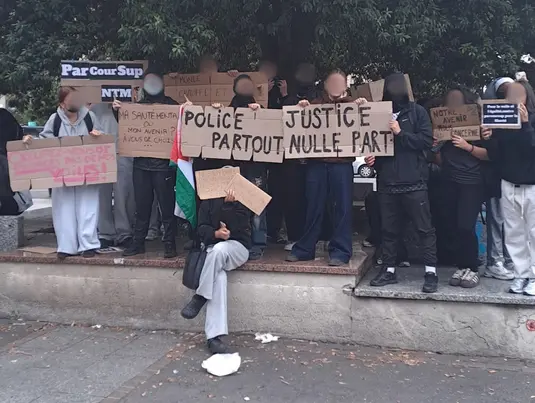
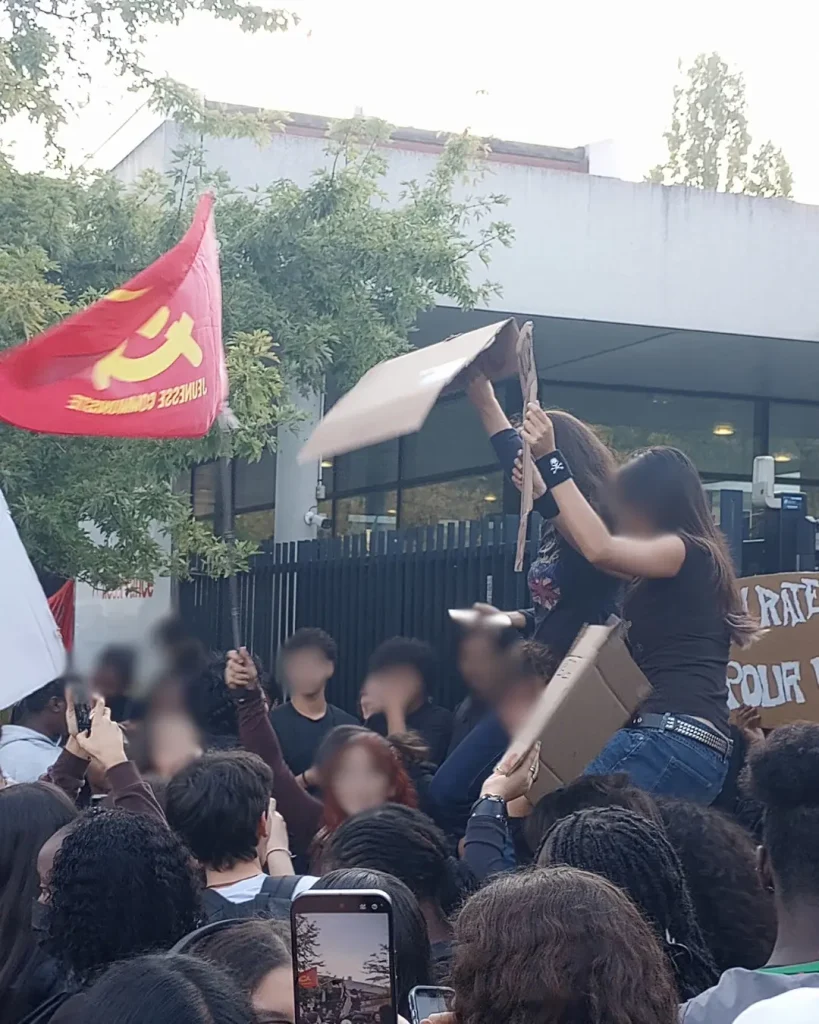
We are on the cusp of a momentous era of profound change, of fire and iron, of a relentless struggle against imperialist barbarism. In this new era, the youth who today are blocking their high schools and standing up to the barbaric violence of the state will form the shock troops of the Revolution. We therefore call for full, complete, and effective solidarity with the movement of high school students in struggle, which is spreading throughout the country. We call on students in struggle to block their universities throughout France in support of the high school students’ struggle. Finally, we call on all revolutionaries to continue and intensify their work in high schools and among the working-class youth, for they are undoubtedly the future of the world!
700 High School Students in the Streets of Saint-Denis and Auber—the Government is Waging War on Us!
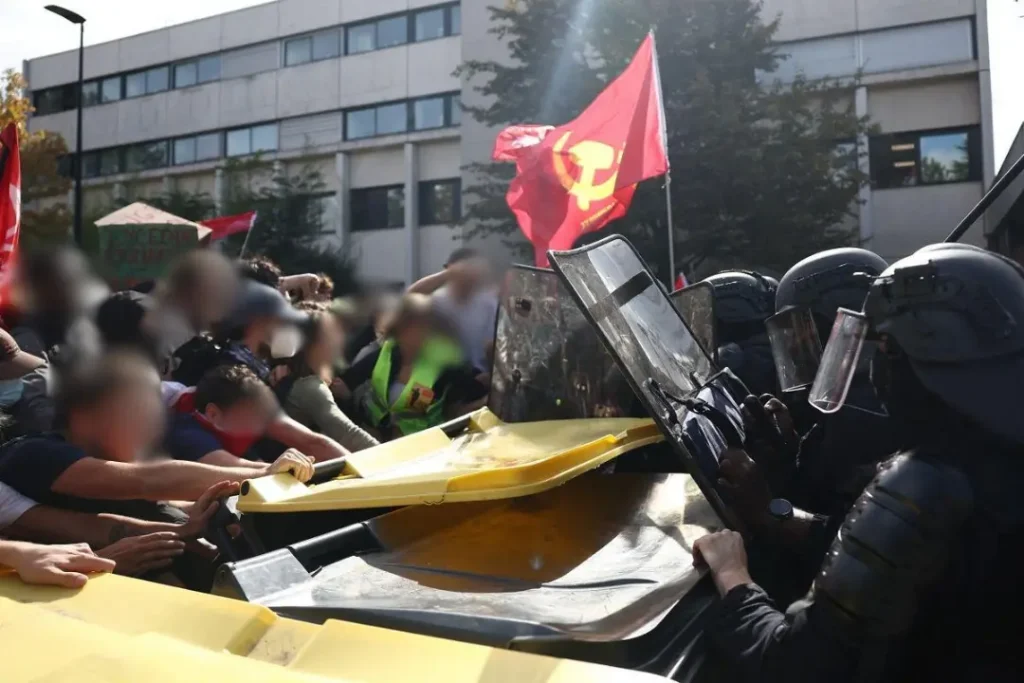
This Thursday, October 1—one week after the first high school blockades in the 93rd department—every high school in Saint-Denis, three high schools in Aubervilliers, and the Maurice Utrillo High School in Stains were blockaded, as were the universities of Saint-Denis and Villetaneuse (a first since 1986!), and an attempted blockade at a middle school in Saint-Denis, for which six National Police trucks were deployed. This was followed by a large, spontaneous demonstration between Saint-Denis and Aubervilliers that brought together 700 high school students, college students, and workers throughout the day. We offer a look back at this day of intense class struggle, driven by high school students who are setting the plains of Seine-Saint-Denis ablaze.
At the ENNA high school in Saint-Denis, students mobilized for more resources for their vocational high school—which has been abandoned by the state—and for respect and dignity, rallying behind a simple slogan: “We’re not dogs! .” The administration attempted to break up the mobilization with conciliatory tactics, proposing that a small delegation come inside the school to speak with the principal. The students responded without hesitation, “No delegation—nobody’s going back inside the school!” thwarting the administration’s attempts and placing the unity of the students at the center. It is this same administration that has been waging a campaign of attacks against the school’s Communist Youth (JC), attempting to sever the link between students and revolutionaries since the start of the school year. Just this morning, a teacher snatched the JC flag from the hands of a young student, only to face protests from the mobilized students. One student shouted, “Why are you doing this? Are communists banned?” Another replied, “It was the communists who defeated the Nazis!” All of this took place on Place du 8 Mai 1945, named after the victory of the great anti-fascist resistance.
At Utrillo High School—which has been mobilized for 15 years against a pedophile and racist teacher—the women students continue to escalate their struggle through blockades, public statements, and banners denouncing the situation and the protection afforded to the teacher by the state and its representatives. Unionized teachers were present and lent their support to the women students, notably by lending them a megaphone. But this blockade was not isolated from the rest of the high school student movement; they also denounce the lack of resources and offer their support for the Palestinian struggle. A young student took to the school courtyard, waving the Palestinian flag, cheered on by the rest of the students.
In Aubervilliers, the 200 students mobilized from Le Corbusier and Henri Wallon high schools directly confronted the state by courageously blocking the national police station located near the two schools. The central aim of this action was to support the high school students who had been arrested following a police charge earlier that morning, and to denounce state repression. Residents of the neighboring district, Vallès-la-Frette, and activists from the CPES came to support the young students early that morning. The police crackdown was accompanied by repression from the administration and staff of Le Corbusier High School. The school counselor (CPE) took photos of the students to report them to their parents and pushed them onto the street toward the police. Another staff member, meanwhile, amused himself by spraying them with water from a hose.
At the blockade of Paris 8 University in Saint-Denis, banners and signs opposing the “Welcome to France” decree—and in support of the mobilized high schools and students without university admission—sprang up at every blocked entrance. The students, eager to join forces with the city’s high school mobilization, were able to help drive out the police who were harassing the students at Bartholdi High School—a vocational school adjacent to the university campus that had been mobilized for a week. Further proof, if any were needed, that youth united in struggle are capable of repelling all attacks by the forces of repression.
Around 10:30 a.m., high school students from Saint-Denis, students from Paris 8, and labor and political organizations converged on Bartholdi High School to set off on a large, spontaneous demonstration through the city. Right at the first turn, the demonstration faced an initial attempt to disperse it. The group did not stop and reached Place du 8 Mai 1945, where high school students from ENNA were continuing their blockade. The square became the scene of clashes between the police and the youth in struggle. Pavement stones were thrown at the police line, and the square was filled with tear gas. The procession then headed toward Suger High School, which was also blockaded, and crossed through the city of Saint-Denis. Upon arriving at Suger High School, 700 young people chanted slogans against the police, in support of those who had been repressed, had their teeth knocked out, or had been blinded, and called for the mobilization to grow ever stronger. A young high school student proclaimed through a megaphone, “We won’t stop until our demands are heard!” Signs bearing slogans such as “Gen Z is communist!” and “Revolutionary Suger!” were held aloft by high school students at the rally.
Around 12:30 p.m., the crowd decided not to stop there and set off on an unsanctioned march to Le Corbusier High School in Aubervilliers. The procession covered 3 kilometers in a combative and festive atmosphere. The police, overwhelmed by the determination of the proletarian youth in motion, were unable to stop the march. The demonstrators even chased away a BAC (anti-crime unit) car that was circling the procession. Upon arriving at Le Corbusier, the high school students from Saint-Denis and Aubervilliers joined forces in direct confrontation with the heavily armed national police lines, which were attempting to “secure” the school’s entrance. For nearly two hours, the high school students and the mobilized youth withstood tear gas and police charges, pushing the officers back further and further. The police eventually retreated, and the students reoccupied the school’s entrance.
Opportunist organizations attempted to break up the mobilization, whose fighting spirit completely overwhelmed them. Révolution Permanente, and their student proxy Le Poing Levé, tried several times to divert the demonstration away from Aubervilliers and send it to another city to “sit down and talk.” This proposal stems from a desire to quash the ongoing high school revolt. Unfortunately for them, the high school students weren’t fooled by their schemes; they booed them during their tedious speeches and remained in solidarity with Le Corbusier, united against the police. We witnessed an exchange between two activists from Révolution Permanente and two high school students, which fully exposed the hypocrisy of their position. One of the high school students replied, quite rightly: “Why should we leave and go talk, when the high school students are right here, facing the cops? We’re not going to leave them alone—that’s why we’re here!”
The demonstration finally resumed, heading toward the d’Alembert High School, driven by young people in solidarity with all their comrades in struggle, chanting: “And for d’Alembert, come on, come on!” Upon arriving at the high school, the mobilized youth attempted to storm the school, to the applause of their comrades. One young person exclaimed jubilantly: “Who does the high school belong to? Is it ours or not?” Once again, the police were overwhelmed and unable to intervene. After half an hour at Alembert High School, it was Rosa Parks High School in Saint-Denis’s turn to receive a visit from the demonstrators, following another spontaneous protest. The goal was to support all the high school students protesting in Saint-Denis and Aubervilliers, as one ENNA student put it so well: “Guys, let’s go to Rosa Parks! They’ve been blocking the entrance since this morning too, but they’re on their own!”
Out of nowhere, the LFI mayor of Saint-Denis, Bally Bagayoko, continued his peacemaking tour of the high school blockades in Saint-Denis. In fact, for several days now, he has been making frequent appearances and delivering speeches calling for “continuing the mobilization but peacefully,” or “not allowing organizations to co-opt the movement politically.” As if he himself weren’t a representative of a political party that, through its elected officials and lawmakers, promotes a nonviolent stance toward the high school blockades, thereby stripping them of their political nature as a profound challenge to the French state.
The day ended around 5 p.m., after a long day of struggle, clashes with the police, and political expression by a proletarian youth from the suburbs. A youth that deeply seeks respect and dignity, that has fully understood that the French state will never grant them these, and that is determined to wrest them away by every possible means of struggle. The state is waging war on the mobilized high school students, and the students are responding ever more forcefully, shaking the bourgeoisie, which is incapable of containing the revolt! Long live the youth of the 93 in struggle! They are right to rebel

No comments:
Post a Comment