

on June 27, 2026, the Peoples Summit Against NATO, organized by the Peoples Front Turkey and the Anti-Imperialist Front, commenced. In the opening speech delivered by representatives from the Popular Front and the “Until Victory” delegation, the anti-imperialist struggle in Anatolia, the fight against SRY-type, the CORPS that US imperialism wishes to establish in Anatolia, and the bloody invasions it would engage in were described. Everyone attending the summit against this corps was greeted. The “Until Victory” delegation spoke about the attacks on Iran and the 168 children from Minab, calling for solidarity with everyone who throws stones at imperialism. The summit began with a one-minute silence for the revolutionaries and peoples massacred by imperialism.
In the session titled “Let’s Establish the Anti-Imperialist Front Against NATO’s Wars, and Against Imperialist and Zionist Aggression,” the moderator was joined by speakers from the Anti-Imperialist Front, the Basque Country, the Palestine Association, and the former Bolivian consul of Barcelona. The participants discussed NATO’s aggression across Anatolia, Lebanon, Palestine, and Latin America, calling for unity against NATO and imperialism. Also in the first session, speakers from Belarus, Borotba from Russia, the PFLP (Popular Front for the Liberation of Palestine) from Gaza, and the Ansarallah government from Yemen, among others, participated via video message.

Following a short break, the second session began. The session, titled “Let’s Organize a Common Front Against NATO, the War Organization of Imperialism,” included representatives from the
In this enthusiastic session, the importance of a common struggle against NATO and imperialism was emphasized by each country’s representative.

he final session of the day, themed “Consequences of Imperialist Attacks and Resistances,” saw both physical and video participation from:
This session detailed various violations of rights and freedoms, their connection to NATO and imperialism, and the resistances organized against them.
Nearly 100 people attended the first day of the summit, which lasted approximately 8 hours. The first day of this broadly attended summit was full of enthusiasm. Despite all cultural differences and the distances between them, the common message shared by more than 40 organizations was: The US cannot survive without building an empire. The US means NATO. The most vital duty of the peoples is to organize resistance and victory against imperialism and its war organization, NATO!
We call upon all our people, as well as anti-imperialist and anti-fascist institutions and organizations, to attend the second day of the summit and the subsequent Grup Yorum concert.
Long Live the Unity of Peoples!
Down with Imperialism, Long Live Our Struggle!
We Are the People, We Are Right, We Wil Win

En estos días posteriores a la segunda vuelta de la elección presidencial en Colombia, los llamados y pronunciamientos desde el Pacto Histórico y la llamada Alianza por la Vida fueron de «esperar en calma los escrutinios», «no movilizarse para no darle razones a la ultraderecha» o decir que «eso es lo que quiere Abelardo», mientras el pueblo comenzaba a plantearse la necesidad de salir a las calles. Ahora que Iván Cepeda y Gustavo Petro reconocieron los resultados —incluso antes de culminar por completo los escrutinios en todo el país y pese a reconocer por parte de Petro la injerencia del imperialismo estadounidense en esa contienda—, la situación para los reformistas conciliadores se reduce al uso de las «buenas maneras democráticas», es decir, el sometimiento a la dictadura de la burguesía, ahora con Abelardo de la Espriella a la cabeza del poder ejecutivo de las clases dominantes.
A nivel nacional y en las diferentes regiones, los dirigentes de la colectividad progre-reformista hacen gala de sus intereses politiqueros y limitan su análisis al crecimiento del caudal electoral por la candidatura de izquierda, lo que denominan «termómetro de nuestras capacidades», sin contrastarlo — por sus obvias limitaciones— con la necesidad del trabajo de base, un horizonte revolucionario y un programa político de la clase obrera y el campesinado pobre hacia la toma del poder, tareas que son de carácter obligatorio para nosotros los comunistas. Para ellos, basta con el cambio nominal de sus reformas a «revoluciones» y pensar en las próximas elecciones regionales, donde de nuevo querrán desviar con su conciliación, la atención del pueblo de su propia emancipación.
Frente a esta situación de absoluto llamado a la pasividad por parte de los reformistas, solo el pueblo salva al pueblo. Es momento entonces de sacudirnos de estos cuatro años de apaciguamiento, quietud contemplativa (incluso entre los revolucionarios) y recordar que la organización y la lucha popular no da espera, y que solo así podremos no solo enfrentar y oponer resistencia, sino efectivamente plantearnos centros de poder propio como semilla para la revolución. Para esto, es necesario que los comunistas y revolucionarios insistamos con las asambleas populares con la clase obrera en las ciudades y los campesinos pobres en el campo, donde el pueblo trabajador organice, decida, y ejecute cómo luchar.
Para que esta iniciativa de poder popular de las masas no quede en lo anecdótico o espontáneo, es necesario agilizar el proceso por la unidad programática de los comunistas revolucionarios en el Partido Comunista Revolucionario, de manera que pueda ponerse al servicio del pueblo como su dispositivo político de vanguardia y destacamento revolucionario que guíe efectivamente esta lucha por su definitiva emancipación contra la burguesía y los terratenientes

Protests were held in Istanbul and Izmir against the operations carried out in Ankara ahead of the NATO Summit
Istanbul
“You cannot stop the course of history—you will end up in the dustbin of history!”
The Alliance Against NATO and Imperialist War stated, “We call on everyone to join the struggle against this summit, scheduled for July 7–8,” in response to the operations carried out in Ankara ahead of the NATO Summit.
June 24, 2026
The Alliance Against NATO and Imperialist War held a press conference in front of the Süreyya Opera House in Kadıköy to protest the detention of dozens of revolutionaries and democrats during Ankara-based raids ahead of the NATO Summit.
During the statement, a banner reading “You cannot stop the anti-NATO struggle with detentions, arrests, and repression” was unfurled, while slogans such as “Withdraw from NATO, close the bases,” “Long live revolution and socialism,” and “Detentions, arrests, and repression cannot intimidate us” were chanted.
Hakan Dilmeç, who read the press statement, emphasized that following last week’s detention crackdown in Istanbul, more than 200 anti-imperialists, revolutionaries, and socialists were detained in Ankara today.
Dilmeç said, “The operations carried out in the early morning hours followed the ban announced yesterday evening by the Ministry of the Interior—aimed at ‘protecting the country’s prestige’ ahead of the NATO summit—which turned Ankara into an open-air prison.”
Noting that many “prestigious” heads of state would be hosted at the NATO Summit, Dilmeç continued: “They will come with the ‘prestige’ they’ve earned by supporting genocidal Israel. They will come with the ‘prestige’ they’ve earned by bombing and massacring 168 schoolgirls in Iran.
They will come with the ‘prestige’ they gained by installing jihadist gangs—which slaughtered Alawites, Druze, and Christians in Syria—as rulers of Syria. They will come with the ‘prestige’ they gained through the wars and massacres they waged against the liberation struggles of oppressed peoples, from Korea to Vietnam.”
Hakan Dilmeç, noting that they were reminding people that NATO is the war and civil war organization of the capitalist-imperialist order, said the following:
“Being a member of NATO means being a part of this order of exploitation and war. The history of the revolutionaries of these lands is the history of the struggle against the NATO order, and it continues uninterrupted. Neither the massacres and coups carried out throughout history, nor the detentions and arrests taking place today, have been able to stop this struggle—and they never will.”
Drawing attention to the fact that the imperialists are planning new wars, massacres, and coups amid a major crisis, Dilmeç said: “But in the face of this, the uprisings and resistance of workers, the oppressed peoples, women, and youth—both globally and on these lands—continue and will continue. No measures you take, no summits you try to convene, will change this reality.”
Dilmeç concluded his remarks as follows: “You cannot stop the course of history; you will end up in the dustbin of history. The true equality and freedom of our peoples can only be defended through the struggle against the NATO order. We call on everyone to join the struggle against this summit planned for July 7–8!”
Izmir
Protest in Izmir against raids and detention terror!
A protest was held in İzmir in response to the raids and arrests in Ankara.
June 24, 2026
A press conference was held in front of the Türkan Saylan Cultural Center in Alsancak by the “No to NATO” Coordination, of which Partizan is a member.
“Repression, bans, detentions, and arrests cannot stop our struggle! No to NATO!” During the protest, where a banner bearing this message was unfurled, the crowd frequently chanted slogans such as “Detentions, arrests, and repression cannot intimidate us,” “Imperialism will be defeated; the resisting peoples will triumph,” and “Long live our organized struggle!”
In the press statement, it was noted that the regime—which does everything to ensure the comfort and ease of imperialist thugs—has intensified its attacks against those who said “No to NATO” ahead of July 7–8.
The statement emphasized that society is being silenced and legitimate reactions are being suppressed through repression, bans, detentions, and arrests, and drew attention to the decision announced yesterday by the Ankara Governor’s Office declaring a state of emergency in Ankara for 13 days, from June 28 to July 10.
The statement noted that NATO, which is coming to Ankara on July 7–8, will make its new war decisions on this soil, and asserted that NATO—the enemy of workers, laborers, and the people—will bring hunger, destruction, and massacres to humanity and the people by devising new plans for plunder and occupation.
The statement emphasized that imperialist barbarism and NATO—an organization of aggression and war—will not be allowed to pass, concluding: “On July 7–8, we will welcome NATO in Ankara as it deserves. Once again, we call on the honorable workers and laborers of this country to unite and fight against imperialist barbarism and the NATO thugs. Those who have been detained and arrested must be released immediately! Repression, detentions, and arrests cannot intimidate us! The NATO summit must be canceled! Withdraw from NATO; close the bases!”

Bolivia. Luego de 50 días, la Huelga General que sacudió al país ha sido traicionada por las cúpulas de la Central Obrera de Bolivia (COB) quienes en días pasados presentaron un plan de 8 puntos aceptando dialogar con el viejo Estado. Este viernes 19 de junio los oportunistas al frente de la COB finalmente se sentaron con el fascismo pactando la desmovilización sin poder garantizarla. El mismo Rodrigo Paz (de quien el pueblo boliviano exige su renuncia) firmó el acuerdo con el canalla Mario Argollo, generando el inmediato rechazo de los movimientos campesinos, indígenas, estudiantiles y populares que se mantienen movilizados pese a la traición. Tras la firma del acuerdo, el régimen fascista decretó el estado de excepción en todo el país, movilizando al ejército y la policía para despejar las carreteras y los puntos de bloqueo que hasta hace una semana tenían al Estado en la lona. De acuerdo con Bandera Roja Bolivia, el día de hoy se reportan aún algunos de bloqueos y existen convocatorias para desarrollar acciones de resistencia por parte de organizaciones como la Federación Sindical Única de Trabajadores Campesinos de la Provincia Omasuyos “Ponchos Rojos” y la Federación Departamental Única de Trabajadores Campesinos de La Paz “Túpac Katari”, entre otras.
In its statement regarding the raids and detentions in Ankara ahead of the NATO Summit, Partizan described the operations as a “political attack aimed at the struggle against NATO” and demanded the release of those detained.
June 23, 2026
As the NATO Summit approaches, Partizan issued a written statement regarding the home raids and detentions carried out in Ankara early this morning. The statement noted that operations were conducted at the homes and organizations of numerous revolutionaries and democrats.
The statement emphasized that the operations targeted revolutionary and democratic organizations.
In its statement, Partizan noted that raids were carried out on the homes and institutions of numerous revolutionaries and democrats early this morning, stating, “As the NATO summit approaches, raids were carried out this morning in Ankara on the homes of hundreds of revolutionaries and democrats—including our comrades—as well as on numerous institutions.”
The full text of the statement titled “Fight Against the State of Emergency Created Under the Pretext of NATO!” is as follows:
This morning in Ankara, as the NATO summit approaches, raids were carried out on the homes of hundreds of revolutionaries and democrats—including our comrades—as well as on numerous institutions.
As in the raids targeting many revolutionary and progressive institutions, dozens of our comrades were arrested under torture after the doors of their homes and dormitories were broken down.
It is clear that this attack was directed against the struggle against NATO. Our struggle against NATO, imperialism, and its local collaborators is just and legitimate!
The ruling class, which declared martial law in Ankara, has long since begun its attacks against the people. NATO, which brings nothing but suffering, plunder, and death to the people, has begun implementing its anti-people dictates just days before the summit. The Turkish state’s rulers, police, and gendarmerie—acting on NATO’s military orders—have once again proven the state’s collaboration with imperialism.
From the very beginning of our struggle, we have stood against this ideology of annihilation, and we will continue to do so. We will not yield to exploitation, torture, or imperialist wars. The martial law measures and political operations carried out under the pretext of the NATO summit will not stop us! These operations prove the legitimacy of our struggle to the entire world!
Release our comrades and our allies in the struggle immediately!
Let us fulfill our revolutionary duty and take to the streets against NATO!
To Ankara on July 7–8!
Down with fascism, down with imperialism, long live our struggle!
Partizan
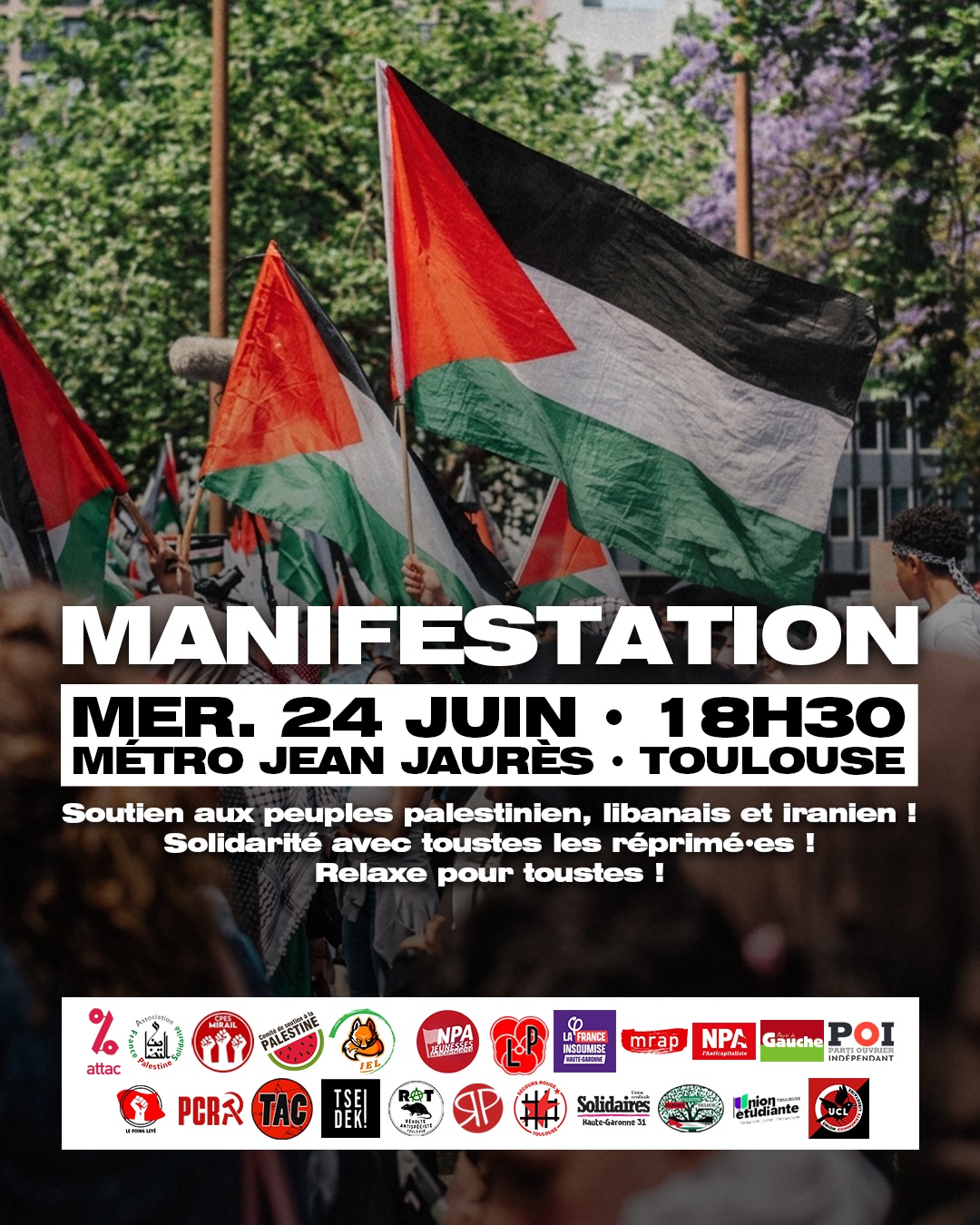
Depuis mars 2026, l’occupation israélienne mène une opération de nettoyage ethnique et d’occupation du Sud Liban, forçant le déplacement de plus d’un tiers de la population du pays, tuant plus de 3500 personnes et blessant plus de 12 000 autres. Des villes, villages et quartiers entiers sont détruits. C’est la même logique génocidaire et de colonisation qu’à Gaza où les bombardements et massacres continuent malgré le cessez-le-feu d’octobre 2025, ou en Cisjordanie où les agressions des colons et de l’armée sont quotidiennes.
Tout ceci se fait avec la complicité des puissances impérialistes, dont la France, qui affiche notamment son soutien à Israel à travers une répression toujours plus forte. D’abord contre les Palestinien·nes : Ramy Shaath est menacé d’expulsion, Omar Alsoumi et Rima Hassan en procès pour apologie du terrorisme ou le réfugié palestinien Ali, en détention provisoire depuis deux ans. Mais de très nombreuses personnes sont également touchées comme Olivia Zemor, présidente d’EuroPalestine, qui a été condamnée à 24 mois de prison avec sursis ou les procès en cours contre des membres d’Urgence Palestine à Montpellier et Pau, de même que des militant-es syndicaux ont été régulièrement inquiété-es par la police ou la justice. Ce 25 juin, Anasse Kazib et un autre militant de Révolution Permanente passeront en procès pour apologie du terrorisme pour avoir dénoncé le génocide en cours en Palestine.
Ce samedi 30 mai à Toulouse, la préfecture a interrompu et dispersé une manifestation déclarée pour demander la libération d’Ali, réfugié palestinien emprisonné en France depuis 2 ans et dont la détention provisoire a été prolongée de 6 mois. La répression de cette manifestation est un précédent innacceptable !
Les organisations signataires appellent à manifester mercredi 24 juin à 18h30 au métro Jean Jaurès contre la répression du mouvement de solidarité avec la Palestine, exiger la relaxe de toutes les personnes inculpées et réaffirmer notre solidarité avec les peuples palestinien, libanais et iranien !
Soutenir la Palestine n’est pas un crime !
ATTAC, AFPS, CPES Mirail, Comité de soutien à la Palestine 31, INSA en lutte, Jeunesses anticapitalistes, Libre Pensée, LFI, MRAP, NPA-A, Parti de gauche, POI 31, Le Poing Levé, PCR 31, Toulouse anti CRA, TSEDEK, Révolte antispéciste Toulouse, RP, Solidaires 31, Solidarité Palestine Toulouse, Secours Rouge Toulouse, UET, UCL
URGENT CALL FOR SOLIDARITY AND ACTION WITH PROSFYGIKA !
Prosfygika is a collective living and resistance community in Athens that has, for years, stood against state repression, eviction attempts and profit-driven redevelopment projects. Through solidarity, collective organisation and a culture of resistance, Prosfygika has become one of Europe’s most important centres of self-organisation and struggle.
At the forefront of this resistance are Prosfygika activists Aristotelis Chantzis and Suzon Doppagne, who are on hunger strike demanding the withdrawal of the eviction plans and the protection of Prosfygika. Aristotelis Chantzis has been on hunger strike since 5 February, while Suzon Doppagne joined the strike on 1 May, strengthening this just struggle.
As of 22 June 2026, Aristotelis Chantzis’s health has reached a critical stage. Following months on hunger strike, he has been admitted to hospital after his condition seriously deteriorated. This development not only places the life of a resistance activist in immediate danger, but also exposes the consequences of the Greek state’s continued attacks on Prosfygika and its refusal to resolve the situation. The Greek authorities bear full responsibility for any harm that may come to Aristotelis by ignoring the hunger strikers’ demands and persisting with their eviction policy.
The struggle of Aristotelis and Suzon is not simply a fight to defend Prosfygika. It is a struggle for the right to housing, for collective living, for solidarity among peoples, and for the defence of the living spaces of migrants, working-class people, the poor and all those who resist. The struggle taking place in Prosfygika today represents a shared front of resistance against the growing policies of repression, eviction, exclusion and profiteering that are spreading across Europe.
At this critical moment, as Aristotelis has been hospitalised, remaining silent would mean turning a blind eye to these attacks. Strengthening solidarity, bringing the voice of the resistance to every community and exposing the Greek state’s repressive policies are urgent responsibilities.
We call on all revolutionary and democratic organisations, trade unionists, labour and democratic forces, migrant organisations, solidarity groups and all people of conscience to organise urgent solidarity actions wherever they are, issue public statements, stand with the Prosfygika resistance, and raise their voices to demand the immediate acceptance of the hunger strikers’ demands.
Aristotelis is not alone!
Suzon is not alone!
Prosfygika is not alone!
We will win — we have no alternative but victory!
Long live international solidarity!
ANG BAYAN
A Hezbollah attack in Lebanon on June 19 killed Lt. Col. Dor Gedalia Ben Simhon, commander of the 52nd Battalion of the heinous Israeli Occupation Force (IOF). The 52nd Battalion is under the 401st Brigade, the unit that brutally killed 5-year-old Palestinian child Hind Rajab and six of her relatives in Gaza on January 29, 2024.
The Hezbollah attack also killed three other IOF soldiers. An strike earlier seriously wounded brigade commander Colonel Meir Biderman. Hezbollah is determined to hunt down everyone involved in the heinous crime of killing the child Rajab.
Rajab’s relatives were killed after Zionist soldiers opened fire at the car they were riding. Rajab managed to call her mother, who sought help from the Palestinian Red Crescent to rescue the child. The Zionists fired as many as 335 bullets while the child spoke with the Red Crescent dispatcher.
The fascist brigade also killed two Palestinian Red Crescent paramedics who tried to reach her. A tank fired on their ambulance in what is called a “double tap strike,” where the Zionists deliberately kill personnel who respond to rescue bombing and attack victims. The remains of nine victims were recovered only after 12 days because the IDF blocked the area.
The people of Lebanon and Palestine celebrated the deaths of Dor Gedalia and the forces of the 401st Brigade. They said this proves no crime of US imperialism and Zionist Israel will go unaccountable. They consider it fully just amid the inutility of international institutions and courts to hold unaccountable the Zionist monsters.
Editorial
For an International Marxist-Leninist-Maoist Conference
PCm Italy: For the Unified International Marxist-Leninist-Maoist Conference
MCC Brasil: Marxism-Leninism-Maoism: The Cornestone of Proletarian Revolution in Our Time
UOC (mlm): The Anti-Imperialist Struggle and the World Proletarian Revolution
Info and debate
Comunist (Maoist) Party of Afghanistan: The Current Situation of the Region and the World...
CC, PBSP/Bangladesh - Our Position/Views on some of the subjects of Debate on the International Line
International Commission of Pcm Italy: who want to “impose Maoism” attack the MLM parties that wage concrete people’s wars
People’s Wars
Communist Party of India (Maoist): Celebrate the 20th Foundation Day Anniversary of the CPI (Maoist)
Communist Party the Philippines: Set to blaze the revolutionary armed struggle for national democracy!...
Joint Declarations
May Day
Palestine
For Saibaba
Special Edition
Joint Declaration on the Occasion of 130th Birth Anniversary of Mao Tse-tung
Declaration of RIM 1993: Long Live Marxism-Leninism-Maoism!
Maoist Communist Party of Italy: Long live Chairman Mao!
Communist Workers’ Union (mlm): On the 130th of Mao and 30th of the Declaration of RIM
Communist(Maoist) Party Afghanistan: Decisively support joint Declaration
Proletarian Party of Purbo Bangla: Comments on the Joint Declaration
Yeni Demokrasi: Maoism, our Rallying Cry for Proletarian Power
Palestine
Communist Party of India (Maoist): We stand with Palestine!
ICSPWI International action's week
Maoist Communist Party of Italy:On Palestine’s situation
People’s Wars
CPI (Maoist): Imperialist War – Revolution
CPI (Maoist): Annals of 2023
Against imperialism, imperialist war, reaction and fascism, the exploitation, misery
and oppression of the proletarians and peoples
For the Democratic People's Revolution and the proletarian and socialist revolution
in every country across the world
The world proletariat celebrates May 1st in a situation of growing danger of a new
world imperialist war, which risks also being a nuclear war.
Imperialism is sinking into the quagmire of the general crisis and all attempts to
overcome it are failing. That is why the main imperialist countries
(USA/UE/RUSSIA/CHINA) are fighting for a new division of the world in order to gain
control of raw materials, of markets in all countries of the world.
Everyday imperialism, its states, its governments, its parliamentary parties, its agents
within the workers' and people's movement take concrete steps towards this new world
imperialist war.
US imperialism in particular, with the Nazi-type presidency of Trump, has raised the
level and intensified the march of imperialist war; It has given full coverage to the
genocide of the Palestinian people. He advanced in the war with collusion and
confrontation with Russian imperialism for the partition of Ukraine. Then, first the attack
against Venezuela, now with the imperialist and Zionist war of aggression against Iran,
aimed to overthrow the governments and establishing new puppet governments in their
place, finding fierce resistance of nation and people in Iran and Lebanon
He unleashed the tariff war to unite the European imperialist powers and all capitalist
and imperialist countries in the world with his plans and interests, facing their oppositions
and various agreements that they feed interimperialists contradditions.
In the meantime, it has unleashed an internal war against the proletarian masses, the
migrants, against the anti-fascist and anti-imperialist opposition, under the banner of
racism, repression, to transform the USA into an open dictatorship at the service of big
capital and on a global scale it works to strengthen and unite all the reactionary, fascist,
Nazi, sovereignist and populist forces of every country.
Towards the countries dependent and oppressed by imperialism it works to unite to its
front the hegemonic powers operating among the countries oppressed by imperialism in
Turkey, India, Brazil, to build the winning alliance in the new world war of partition, while
nurturing and strengthening chauvinism, nationalism and fundamentalism.
US imperialism wants to get out of crisis and decadence through war, and the other
imperialist powers, large and small, want to defend their specific imperialist interests.
All this leads to a situation in which in every country states and governments are getting
equipped to participate in the war with rearmament, the war economy, the unloading of the
crisis and the costs of the war on the proletarians and the peoples.
Inequalities between rich and poor in the world are growing more and more, poverty
worsens the more the world economic crisis worsens. The capitalist/imperialists' race for
profit is leading to social and environmental catastrophe. The so-called "third, fourth
industrial revolutions" do not bring innovations for the development of mankind but are
tools for accumulating more and more capital through financial capital.
Imperialist and reactionary wars are creating hundreds of thousands of refugees, poverty
and unemployment are pushing populations from the semi-colonial regions of dependent
countries, oppressed by imperialism to capitalist/imperialist countries.
The ruling classes of the capitalist/imperialist countries, as well as those of the countries
oppressed by imperialism, are breathlessly trying to keep themselves in power both
through elections aimed at changing the faces of the governments at their service but not
the substance of power. And where there is a massive abstentionism, they openly point to
fascist-type governments and regimes and police states, open dictatorships.
In the face of all this, the proletarians, the popular masses, the peoples oppressed by
imperialism have no other way than to intensify the struggle, develop social and popular
upraisings, armed struggles, launching people' war and movements aimed at overthrowing
reactionary governments serving imperialism and the ruling classes.
These movements demonstrate with their strength and their limitations that there is no
alternative to the path of Revolution: New Democratic Revolutions, Socialist Revolutions.
The main instrument for making revolution is the revolutionary party. Building and
strengthening the communist parties, defending them from the plans of the bourgeoisie to
annihilate them ( specially against maoists: Operation Kagar in India, Repression in
Philippines,Turkey etc) is today the main task and the key to advancing the proletarian and
popular movements in all countries of the world.
Only the construction of the Marxist-Leninist-Maoist Communist Party allows the
development of the proletarian and people's united front and the creation of the people's
and proletarian army necessary for the overthrow of the ruling classes in each country and
of the imperialist system on a world scale.
The Marxist-Leninist-Maoist Communist Parties must be formed and developed in the
fire of the class struggle strictly linked with the masses, as workers' vanguard detachments,
units capable of leading the proletarian and popular struggle, the political struggle, in the
context of the different countries, to develop the class war, the revolutionary war, the
people's war.
Marxist-Leninist-Maoist communist parties capable of analyzing the errors and defeats
of the communist movement, of the past as well as those of today; capable of guiding the
direct experience of the proletarians, of the masses and the movements of struggle.
The communist parties engaged in the people's war and all parties and organisations that
work for this and for the revolution must play a vanguard role, in a costant struggle against
revisionism and 'leftism', for building the international communist organization, an unified
international organization, under the banner of Marxism-Leninism-Maoism to lead the
proletariat and the popular masses in the capitalist, imperialist countries and countries
oppressed by imperialism in the revolutionary struggle for socialism.
To this aim, it is necessary to create today a unitary International Communist Forum
capable of helping to lead the proletariat in the capitalist and imperialist countries and in
the countries oppressed by imperialism in the struggle, mobilizing all the anti-imperialist
forces, the national liberation movements and the advanced parts of the movements
against war, fascism, reaction and repression, genocides, territorial and environmental
devastation.
This is today the necessary stage to advance in the reconstruction of the International
Communist Movement and a new Communist International.
The world is faced with the epochal clash between imperialist war and revolution for the
liberation of proletarians and peoples.
The teachings and slogans of Lenin and Mao are back really clear
Lenin
'Transforming the imperialist war into a civil war’
'Imperialism is the dawn of the world revolution of the proletariat'
'There is one and only one kind of real internationalism and that is - working
unconditionally for the development of the revolutionary movement and revolutionary
struggle in one's own country, supporting (with propaganda, solidarity and material aid)
this struggle, this and only this line in every country without exception'
Mao
"History shows that wars are divided into two categories: just wars and unjust wars. All
progressive wars are just, and all wars that impede progress are unjust. We communists
oppose all unjust wars that impede progress. We communists not only do not oppose just
wars, but we actively participate in them. The First World War is an example of an unjust
war: the two sides fought for imperialist interests, and that is why communists all over the
world resolutely opposed it. The means of opposing such a war is to do everything
possible to prevent it before it breaks out, but once it has broken out, one must oppose the
war with war, oppose the unjust war with the just war, whenever possible."
signatures until now
Alkadihines Party - Tunisia
Communist (Maoist) Party of Afghanistan (CMPA)
Communist Party of Nepal (Bahumat)
Communist Party of Switzerland
Communist Party of Turkey - Marxist-Leninist (TKP-ML)
Communist Unity - France
Communist Worker Union (mlm) Colombia
Italian(Marxist-Leninist) Party
Maoist Communist Committee Brazil
Maoist Communist Party – Italy
Proletarian Party Of Purbo Bangla(PBSP/Bangladesh)
Red Road of Iran (Maoist group)
Revolutionary Communist Party of Nepal
Yunshuinu Group - China
Organization of the Workers of Afghanistan (Marxist-Leninist-Maoist principally Maoist)
Communist Party of Switzerland
Comunist Detachement Flag Sud/Korea
Gongge News Redaction (Cina)- workers'revolutionary newspaper
Lal Morich - Bangladesh

The National Democratic Front of the Philippines (NDFP) successfully led the 6th International Theoretical Conference (ITC) on May 22–23 in Kathmandu, Nepal, bringing together nearly 200 delegates from 17 countries to examine the theme, “Fascism and Imperialism in Neocolonies in the 21st Century.”
The gathering drew representatives from communist parties, workers’
parties, revolutionary organizations, national liberation movements,
party-building groups, and progressive organizations. It served as the
second of two consecutive international conferences devoted to the study
of fascism in the contemporary period, following an earlier conference
that focused on fascism in imperialist and industrialized capitalist
countries.
Through discussions of 17 theoretical papers,
participants deepened their understanding of fascism as a product of the
intensifying crisis of imperialism. Delegates analyzed how imperialist
powers and their client regimes employ fascist methods, including
counterinsurgency programs, militarization, surveillance, and political
repression, to preserve exploitative social relations and suppress
popular resistance.
The conference drew from the theoretical
contributions of Lenin, Stalin, and Georgi Dimitrov, as well as lessons
generated from the NDFP’s previous theoretical conferences. Discussions
emphasized the need to understand the historical evolution of fascism in
neocolonial societies and to build broad united fronts among workers,
intellectuals, peasants, national minorities, and other oppressed
sectors to confront and defeat fascist rule.
A key contribution
came from the Central Committee of the Communist Party of the
Philippines (CPP), which presented the paper “Wage the People’s War to
Uproot Fascism and Imperialism in Neocolonies.” The paper traced the
development of fascism in the Philippines, distinguishing it from the
fascist movements that arose in imperialist countries. According to the
presentation, fascism in the Philippines was imposed through a
neocolonial state structure shaped by US imperialism and reinforced
through counterinsurgency doctrines, anti-communist campaigns, and
repressive legislation.
The conference concluded with a synthesis of
discussions, tributes to martyrs of revolutionary struggles in
neocolonial countries, and the singing of The Internationale.
The
conference’s analysis finds a striking contemporary example in Bolivia,
where a deepening economic crisis has triggered widespread protests by
workers, farmers, miners, indigenous communities, transport workers, and
teachers. Demonstrators have mobilized against inflation, fuel
shortages, austerity measures, and policies perceived as favoring
corporate interests at the expense of the people.
Rather than
addressing the root causes of the crisis, the government of President
Rodrigo Paz has increasingly relied on coercive measures. Authorities
deployed thousands of police and military personnel to dismantle road
blockades, expanded executive emergency powers, and adopted rhetoric
portraying protesters as “narco-terrorists” and agents of
destabilization. Trade union leader Mario Argollo faces terrorism
charges, while hundreds of protesters have reportedly been arrested.
While
the Bolivian government has offered limited concessions, it has
simultaneously intensified militarized responses to popular dissent. For
many observers, these developments reflect the very tendencies
discussed during the NDFP-led conference: the use of state repression,
emergency powers, and criminalization of mass movements to preserve an
increasingly unstable social and economic order amid deepening crisis.
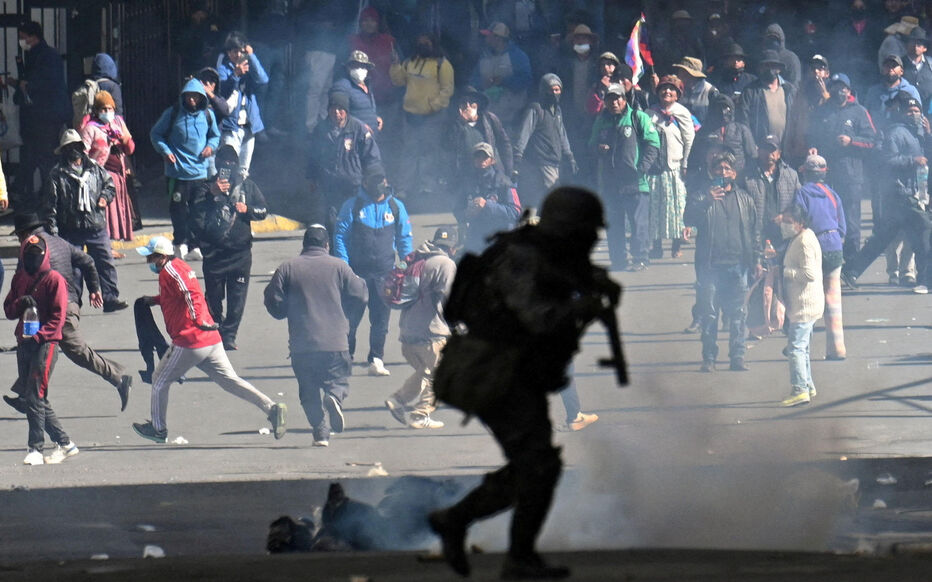
Le président bolivien Rodrigo Paz a annoncé le 20 juin 2026 l’instauration de l’état d’urgence sur l’ensemble du territoire pour une durée de 90 jours, afin de faire face à des blocages routiers et à des mobilisations paysannes qui durent depuis plus de 50 jours. Le gouvernement justifie cette mesure par la nécessité de rétablir la circulation, tandis que des organisations rurales dénoncent une réponse répressive à une crise sociale et politique.
Le décret autorise la Police nationale et les Forces armées à intervenir pour lever les blocages, y compris par la force. Une partie du mouvement a entre-temps signé un accord avec la Centrale ouvrière bolivienne (COB), sans mettre fin aux mobilisations les plus déterminées, notamment dans les zones rurales. Le gouvernement accuse certains groupes de « déstabilisation » et de « narco-terrorisme », des termes visent à légitimer une politique de criminalisation des protestations.

Comunicado de la Oficina de Relaciones con los Medios de Comunicación de Hezbollah
Ante las acusaciones y falsedades que el enemigo "israelí" sigue promoviendo respecto a que Hezbolá ha violado el acuerdo de alto el fuego, en un intento de justificar su continua agresión contra el Líbano y las masacres que está cometiendo contra civiles, la Oficina de Relaciones con los Medios de Comunicación de Hezbolá afirma que dichas acusaciones carecen por completo de fundamento y se enmarcan en los continuos esfuerzos del enemigo por engañar a la opinión pública, así como en su manifiesto y evidente intento de sabotear el acuerdo entre la República Islámica de Irán y los Estados Unidos de América.
El número de violaciones y ataques registrados tan sólo desde esta mañana ha alcanzado no menos de 180 incidentes, con un saldo de más de 28 mártires, entre ellos tres soldados del Ejército Libanés, y 35 heridos.
Está firmemente comprobado que este enemigo engañoso y traicionero jamás ha respetado las disposiciones de los acuerdos de alto el fuego, ni el 27 de noviembre de 2024, ni el 8 de abril de 2026, ni tras el anuncio del memorando de entendimiento entre Irán y Estados Unidos el 14 de junio de 2026, ni siquiera ayer, viernes 19 de junio de 2026. Por el contrario, ha continuado violando y quebrantando la soberanía libanesa mediante ataques aéreos, bombardeos, destrucción de viviendas, intimidación de civiles y asesinato de personas inocentes.
Estos hechos, evidentes para cualquier observador, demuestran claramente cuál de las partes está violando el acuerdo de alto el fuego y socavando las conversaciones existentes. De hecho, lo que el enemigo "israelí" está cometiendo mediante estos ataques y masacres ya no es simplemente una violación del acuerdo de alto el fuego, sino que constituye una agresión flagrante y una continuación de la guerra en todo el sentido del término.
En consecuencia, la responsabilidad recae plenamente sobre el ocupante "israelí", cuyos funcionarios declaran reiteradamente y públicamente su rechazo a los acuerdos vigentes y su negativa a retirarse del territorio libanés ocupado. Todos los países y funcionarios, principalmente Estados Unidos, deben presionar a la entidad ocupante, obligarla a implementar los acuerdos y cesar sus ataques, en lugar de lanzar acusaciones indiscriminadamente.
Hezbollah afirma que el Líbano, su pueblo y su Resistencia tienen derecho a defender su tierra y soberanía frente a los continuos ataques y violaciones "israelíes". Nadie puede legalmente privarlos de este derecho, garantizado por todas las leyes y principios jurídicos internacionales. Además, la impunidad con la que el enemigo pretende imponerse para continuar su agresión es inaceptable y no quedará sin respuesta; la expulsión del ocupante de nuestro territorio es sólo cuestión de tiempo.


