
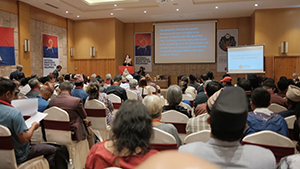
The National Democratic Front of the Philippines (NDFP) successfully led the 6th International Theoretical Conference (ITC) on May 22–23 in Kathmandu, Nepal, bringing together nearly 200 delegates from 17 countries to examine the theme, “Fascism and Imperialism in Neocolonies in the 21st Century.”
The gathering drew representatives from communist parties, workers’
parties, revolutionary organizations, national liberation movements,
party-building groups, and progressive organizations. It served as the
second of two consecutive international conferences devoted to the study
of fascism in the contemporary period, following an earlier conference
that focused on fascism in imperialist and industrialized capitalist
countries.
Through discussions of 17 theoretical papers,
participants deepened their understanding of fascism as a product of the
intensifying crisis of imperialism. Delegates analyzed how imperialist
powers and their client regimes employ fascist methods, including
counterinsurgency programs, militarization, surveillance, and political
repression, to preserve exploitative social relations and suppress
popular resistance.
The conference drew from the theoretical
contributions of Lenin, Stalin, and Georgi Dimitrov, as well as lessons
generated from the NDFP’s previous theoretical conferences. Discussions
emphasized the need to understand the historical evolution of fascism in
neocolonial societies and to build broad united fronts among workers,
intellectuals, peasants, national minorities, and other oppressed
sectors to confront and defeat fascist rule.
A key contribution
came from the Central Committee of the Communist Party of the
Philippines (CPP), which presented the paper “Wage the People’s War to
Uproot Fascism and Imperialism in Neocolonies.” The paper traced the
development of fascism in the Philippines, distinguishing it from the
fascist movements that arose in imperialist countries. According to the
presentation, fascism in the Philippines was imposed through a
neocolonial state structure shaped by US imperialism and reinforced
through counterinsurgency doctrines, anti-communist campaigns, and
repressive legislation.
The conference concluded with a synthesis of
discussions, tributes to martyrs of revolutionary struggles in
neocolonial countries, and the singing of The Internationale.
The
conference’s analysis finds a striking contemporary example in Bolivia,
where a deepening economic crisis has triggered widespread protests by
workers, farmers, miners, indigenous communities, transport workers, and
teachers. Demonstrators have mobilized against inflation, fuel
shortages, austerity measures, and policies perceived as favoring
corporate interests at the expense of the people.
Rather than
addressing the root causes of the crisis, the government of President
Rodrigo Paz has increasingly relied on coercive measures. Authorities
deployed thousands of police and military personnel to dismantle road
blockades, expanded executive emergency powers, and adopted rhetoric
portraying protesters as “narco-terrorists” and agents of
destabilization. Trade union leader Mario Argollo faces terrorism
charges, while hundreds of protesters have reportedly been arrested.
While
the Bolivian government has offered limited concessions, it has
simultaneously intensified militarized responses to popular dissent. For
many observers, these developments reflect the very tendencies
discussed during the NDFP-led conference: the use of state repression,
emergency powers, and criminalization of mass movements to preserve an
increasingly unstable social and economic order amid deepening crisis.

No comments:
Post a Comment