
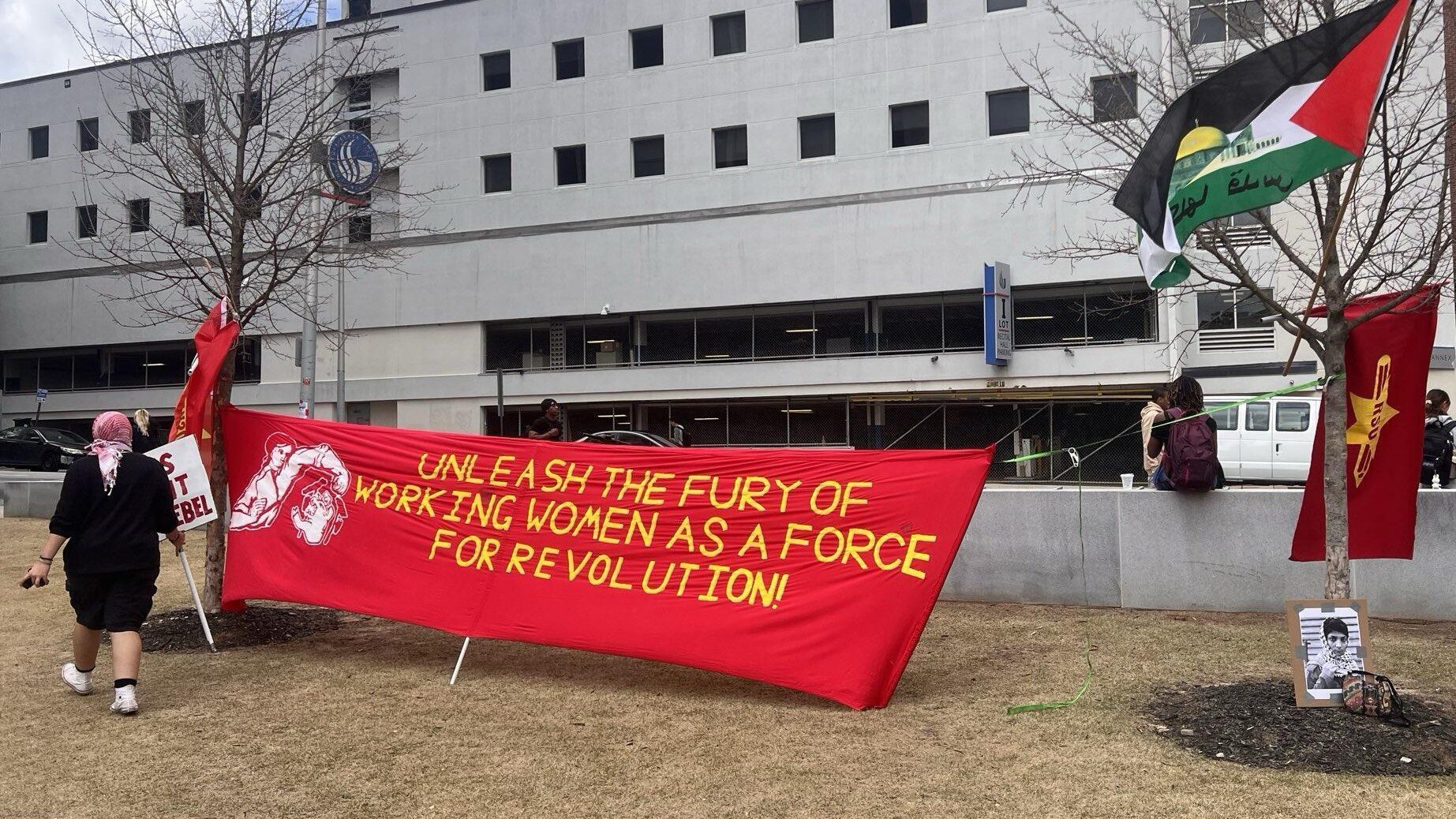
[Editorial Note: The Partisan spoke with activists of the Revolutionary Student Union – Georgia State University, a revolutionary student organization, which has faced State repression for hosting a militant rally on March 8 in celebration of International Working Women’s Day. The activists detailed the repression they face, history of repression in the university, and its ties to gentrification, Zionism, and organized fascists. The activists stressed the student struggle is not separated from class struggle in the society as a whole, as “the University is not legally separate from the State,” and the need to fight opportunist forms of “resistance” that don’t challenge the class enemy.]
Can you tell us a little about the protest? How did it start and what happened?
Our demonstration was intended to mark the annual celebration of International Working Women’s Day, a historically significant red holiday for progressives and revolutionaries worldwide. We spent many days working in preparation: materially, we crafted a large banner, wheat-pasted posters, made picket signs, produced portraits of renowned women revolutionaries, wrote and practiced our speeches; logistically, we scouted for the best locations, reached out to mass contacts and local supporters for their help, and drafted plans for potential reaction from enemy forces.
Initially, the plan was to occupy a one-way street that had already been closed off by a construction crew for weeks, have a local punk band play a loud set, deliver our speeches and lead in chants, and promote the urgent need to organize – all while passing out literature, of course. However, despite what construction workers told us and the best information we could find online, the road had reopened less than two days before the action, forcing a change in tactics. A few activists decided in haste to relocate the electric scooters that had littered the nearby sidewalks to the entryway of the now accessible crosswalk, stubbornly keeping to the original idea of taking the street.
By noon the next day, two activists were dashing to escape the police. There were plans to occupy a recently closed street which had been reopened the night before, but before any actual rallying took place, the police arrived on the scene. According to multiple witness testimonies, the activists were walking away from the scene when an officer behind them began describing one of their appearances on a radio, and another officer loudly said “Hey!” before the two ran. Unfortunately, an officer intercepted the activists’ path and drew their taser, commanding the two to get on the ground. From then until the following morning, the two activists were evidently helpless, stuck inside a jail infamous for its inhumane, violent, and hazardous conditions. From the accounts of our comrades who were at the scene as the students were being arrested, uninvolved students had been told that the reason for the activists’ arrests was because they planned to shoot up the school.
According to students, police had called the arrestees “suspicious for having backpacks,” and had stated that they were willing to open fire and shoot into Langdale Hall if needed. One of our comrades had asked several of the officers involved for their badge numbers, so as to procure body cam footage eventually. In response, she was met with condescension and pettiness. One cop gave his badge number without issue, but most of them ignored her. One cop said the badge number very quickly and quietly and then swiftly left on a motorcycle with another cop as she was telling him that she didn’t get the number. We have recorded footage of this. Even after this, a dozen or so students and local community members tried to continue the event against every wish of the university administration. Anthony Davis, the Dean of Students, made a special appearance – not to address the distressing arrests, but to request that the university property be undressed.
In the interaction that ensued, Mr. Davis flawlessly exposed the contradiction in the way the university presents itself. He explained: “So, the university doesn’t have a stance on any issues. The university- what you all, as students, can have whatever stance you want, right, and our job is to support you and make sure you understand-” A voice interjected, “Don’t you think that GILEE is an implicit stance for killing Palestinians? I kinda feel like it is.” Mr. Davis quickly replied, “I have no comment on that. Like I said, the university does not take any stance on social issues.” It suffices to say that the university takes stances on social issues when it arrests its own students for rebelling against patriarchal domination and imperialist aggression. It doubly suffices to say that the university takes stances on social issues when it houses a program like the Georgia International Law Enforcement Exchange to send law enforcement of all commands to train with and exchange technology with their Zionist counterparts in Occupied Palestine, bringing back toys like Cop City and Operation Shield, chiefly at the expense of the working and nationally oppressed peoples not only of Atlanta but of the whole world.
What is Georgia State University’s public response to the repression?
Georgia State University has been anything but public about the incident. In its various promotional materials, the university has a habit to pride itself on having been built by student protest. In reality, it relies on its very own police department to stamp out any and all real student resistance. We say real because we acknowledge that there exists a kind of “resistance” that is compatible enough for the university to allow. This kind of “resistance” is generally widespread among the student activism circles and organizations on campus because it gives its participants the ability to claim the easiest of victories without having to seriously struggle against the enemy, essentially the means for a massive ego-boost. Despite the good intentions of many organizers whose work may fall into this category, this compatible “resistance” only serves the university’s interests to appear benevolent, to disarm and dissuade the students of conscience from politicizing, mobilizing, and organizing the masses. It must be corrected and opposed accordingly with real resistance, distinct because it is attacked by the enemy.
Can you tell us a little about Georgia State University’s history against working-class and progressive student organizing?
Given that we are a relatively young
chapter that was effectively constituted over these past two semesters,
none of our members were present for any of GSU’s historical involvement
in repressing working-class and progressive student organizing.
However, from our research and our connections with local organizers who
were active during their time as GSU students, we have assembled a
rough picture of certain events:
White nationalists and
neo-nazis have had a history of organizing on campus and holding
school-sponsored events where hundreds of students would show up. In
2016, students who were being mentored by an older confederate invited
Milo Yiannopoulos – a gay, alt-right, pro-Trump political commentator–to
speak on campus at GSU. They would invite far right commentators in
order to grow and consolidate their movement on campus, which included
actions like disrupting and intimidating black students at events that
were hosted to address issues faced by students of color. In 2015 they
disrupted the “Symposium on Race, Urban Culture and Campus Diversity,”
hosted by the Greatest MINDS, an organization which aimed to “promote
scholarship, excellence, leadership and high achievement among the
African American and minority student populations and groups […] on
campus.”
Since Yiannopoulos is criticized within the alt-right for seeming to not truly believe racial supremacy, these extreme neo-nazi students would go to his events and pass out materials to represent the “core” of the alt-right to further radicalize the people who attended. They would also put up posters and stickers with neo-nazi propaganda and dog whistles everywhere on campus. When anti-fascist student organizations would spread awareness and information about these neo-nazi organizers, the neo-nazis actually responded by calling GSUPD on them, which resulted in the arrest of one anti-fascist student. Though the student involved could not be charged with any crime, the university responded by pursuing disciplinary action against them. The neo-nazi student organizer who called GSUPD on the anti-fascist activists, Spencer Madison, was noted to be very friendly with the police, and the police were also reportedly very friendly with him. Reportedly, they would engage in conversation and often go on walks. The main head of the neo-nazi movement on campus was a student named Patrick Sharp, and a close associate of his was named Christian Meehan, who was a part of the Greatest MINDS disruption. According to witnesses, Meehan had jeered and commented “that the reason Black history is not discussed in history courses, etc. is because [of] the lack of contribution to greater world history made by Africans.” Meehan was also the Director of Communications for GSU College Republicans in 2015. GSU never pursued any action against these neo-nazi students and, obviously, these students have never faced any police repression either.
In the mid-2010s, for the purpose of developing the Turner Studium into GSU Stadium and the surrounding neighborhoods into a retail district, GSU partnered with Carter Development to buy out and demolish the neighborhoods of Summerhill, Mechanicsville, and People’s Town. This development was a net negative for the surrounding community, as it destroyed the places where they used to live and work. These communities were well aware that the effects of this development would be negative, as they have historically been affected by gentrification and development projects like this. Before the Atlanta Braves left Turner stadium (now GSU stadium), their home stadium was the Fulton county stadium, which was right next to Turner Field, and that had been there since the 60s. There was a brief period where they had just finished Turner Field and they were both next to each other. Before the development of the Fulton County stadium in the 60s, there was a highway development in the 50s that came through these neighborhoods. Since the 1950s (before the civil rights era), these places were constant sites of capitalist developments that demolished houses, displaced residents, made living conditions worse, and provided no decent sustainable jobs. A lot of the jobs provided through these stadiums were seasonal, temp, low paying jobs like janitorial or service work. During these developments, which GSU invested in and was the main beneficiary of, students from that time remark that the area astonishingly appeared to look like a warzone. It looked like it was ruthlessly bombed. A neighborhood full of condos and restaurants just turned into rubble all of a sudden.
In the midst of this, a student organization called USAS, United Students Against Sweatshops, became the center of the student movement to advocate for the residents. In 2016. USAS established a relationship with Tim Franzon. He was part of the group Occupy our Homes in the Occupy era, and he also formed the Housing Justice League. This was all mainly eviciton defense, some of which happened in these neighborhoods, so he had good relations with a lot of residents and was able to put USAS in contact with them. Their line did not stand against the gentrification as a whole, but wanted the president to sign a community benefits agreement. The idea was that the residents, the university, and Carter Development would come together and craft an agreement that would have clauses in the development contract that would make it to where it would harm the residents less. Many students understood that gentrification was an economic process and not something that could be negotiated in contracts, but this was the line of the group. The residents even had a CBA draft drawn up. They said “we just want Becker (then president of GSU) to come to the table.” There were posters made about how much Mark Becker made every year comparing it to the salaries of professors. There were attacks levied against him from all angles during this time and there were constant protests on campus around this development. The Signal, GSU’s official school newspaper (which has won a good few awards but has since been defunded by the university) would write exposes on the development which frustrated the school quite a bit.
At one point, President Becker would pin
articles in the student newspaper and accuse student activists of
telling lies about him. He also had to have intense public interventions
begging students not to protest. The protests consisted of speak-outs,
assemblies with speeches, and marches with banners. One of these marches
lead up to a sit-in in the presidents office, which resulted in the
arrests of several student activists. After this, the main escalation
was a march to the stadium organized by USAS and Tim Franzon, which
resulted in some students establishing an occupation on the grounds. It
was a relatively small occupation (around 5-10 people at any given
point, sometimes there was an influx of supporters) which lasted for
about a week or so. There were tents and signs and such, and there was a
large police presence consisting of APD and GSUPD. The police would try
to break up the occupation when there were less people, but people went
back to establish it. Eventually the occupation died out, but it is
unknown whether it slowly withered away or the police forcefully cleared
it out at once.
In 2017, GSU PD began a campaign of harassment
against any groups who tried to share food with homeless people
downtown, most notably Food Not Bombs. The police have had no consistent
or coherent legal basis for targeting this organization, they simply
want homeless people out of the park and out of Atlanta. This harassment
against Food Not Bombs followed shortly after the city of Atlanta shut
down the largest homeless shelter in the city. “Developers, university
administrators, and city planners do not care that there’s nowhere for
poor people to go. As far as they are concerned, the homeless are a
nuisance to be dealt with the same as rats and pigeons.”
Your organization said in a statement that “we are entering a period where the fascistization of society is manifesting in our schools”. What is your understanding of this question, and how can working class students play a role in this fight?
We understand that the United States has been undergoing fascistization. Put briefly, fascistization (i.e., the rise of fascism) is the centralization of power under the executive branch of the old State to negate the traditional liberal-democratic order with the open dictatorship of monopoly capital. It is a national reorganization towards another form of class rule by the capitalists, and is either established or dismantled based on their needs. Accordingly, in the sphere of education in general and universities in particular, institutions like Georgia State University play their role in and undergo this process as well. The public university functions as a state institution to maintain and reproduce capital by producing “education” and “knowledge” as commodities, as well as by producing the skilled section of the workforce (contributing to the endless division of labor). In their production of this skilled sector, they usually enter give-and-take partnerships with businesses which fund their research and/or professional programs, and in return they produce a certain number of graduates that can perform certain types of specialized labor. They advertise these business-STEM partnership programs to students who are currently in programs like nursing, public health, and pre-medical. While they do this, they also cut funding for programs in the humanities and don’t maintain enough class sections to help students in fields outside of certain professions of interest (which are usually in line with the technologies and methods by which capitalists are looking to invest in to maximize their profits).
Aside from this, the university serves as a point of transaction and organization between state and business forces, most notably through the GILEE program, the Georgia International Law Enforcement Exchange. The most frequent and influential foreign entity that this exchange happens with is the Zionist occupation. It is subsidized by the DOJ and receives grants and donations from private corporations and entities through the GSU Foundation. We have a genocidal occupation that targets civilians teaching our law enforcement their lethal tactics and surveillance mechanisms. We can see in the history of the GILEE program that its main affiliations and participants all have corporate interests that they defend through the escalation of militarization against the domestic population.
Some of the participants in GILEE’s Business Continuity Summit meetings have included representatives from the DHS, ICE (who also train with the Zionistoccupation forces), the FBI, Lockheed Martin, and the U.S. Attorney’s Office. GILEE also partners with ASIS International, an international weapons showcase that links weapons manufacturers with local, state, and national foreign and domestic governments. It is also partnered with the Building Owners and Managers Association of Georgia, the Atlanta Police Department, and the United States Secret Service. This program, housed by GSU in Atlanta, which is one of the most surveilled cities in the world (no coincidence there!), is a prime example of the consolidation of law enforcement with state and corporate interests against the working and oppressed people of the world. This is a war being waged upon us as we are witnessing constant shocks of brutal and existential violence across the globe, alongside increased economic decline and impoverishment for the working class. We see that the state continues to pursue policies that compound our economic pressures and compromise our safety and our futures for the sake of preserving the gains of corporations like Palantir, Raytheon, Google, Meta, and countless more startups. We can see this as tech companies develop and sell surveillance and AI technology for military purposes and enforce their usage in the domestic sphere and in government offices, while politicians and their big bourgeois venturers continue to squeeze a profit from their speculative investments in these bubbles. These technologies are tested by the zionist entity to commit genocide against the Palestinians and then are brought back here to be used by ICE and the police to brutalize and terrorize the people in its own territories. Using the violent power of the state and the ever-watching eyes of mass surveillance technology, our needs and livelihoods become monitored threats to capital, and we all become potential criminals.
The owners of capital own everything we need to live, use us to reproduce and maintain them, and to sell them back to us to become richer so as to continue to expand their power into a smaller and smaller set of hands–and the state is evolving into a more aligned and efficient vehicle for this development. The maintenance of global capitalist financial oligarchy is the cause of chaotic struggle across the globe, and is maintained and invested in through state institutions as well as bailed out by the state when the warlike chaos of the system backfires on them. The university is such an institution, and its role again is a unification of the interests of the state and of business. Universities consistently invest in land, private equity, weapons, and surveillance technology. The property of public universities is the same as that of the state, and they utilize “non-profit” foundations to continuously invest in finance capital and land for rent to generate millions of dollars in revenue and to once more funnel money into imperialist machines like the GILEE program or other monopoly-allied programs that serve to protect and reproduce capital. In the words of GSU itself, “the University is not legally separate from the State” and the GSU Foundation (GSUF) is listed as a “legally separate, tax-exempt component of the State.” In 2025 alone, the GSUF made more than $7 million in revenue after making $5.8 million in rental income, and making back more than $6.5 million from investment returns from direct financing leases. Their 2025 investments resulted in a net asset value per share from hedge funds and venture capital-private equity at $190,243,670. It is not only GSU which engages in landlordism, gentrification, and militarization between state and corporate interests. Most Atlanta universities also maintain revenue by buying up property, and universities like Georgia Tech and Emory also consistently invest in and partner with companies that directly contribute to war and genocide, such as Raytheon, Boeing, and RTX. Within every institution that serves to maintain and reproduce capital, the violence that is necessary to maintain it is present, and the university is no different.
What are some ways you can be supported?
Among the tools used in the repression of these students are exorbitant financial costs. Both students owe thousands of dollars as a result of their arrest and will continue to face additional costs as they defend their legal case. For that reason, one of the best and most immediate ways to support the students is to donate to their legal fund here, in addition to sharing the URL to their legal fund with others. Any donation provides the students with much-needed support as they navigate this burden.

No comments:
Post a Comment