
In the present moment, Indian revolutionaries are facing steep repression and attack on all sides. Despite this, genuine comrades persist in the struggle to preserve the subjective forces and ensure the continuation of the Indian Revolution. As part of this process, liquidationist, revisionist, and opportunist elements within the movement are being weeded out bit by bit. The comrades at bsCEM are criticizing Vishwavijay and Seema Azad, two former revolutionaries who abandoned the struggle for several years and aimed to liquidate as much as possible, and destroy the Party’s political lines in service of their individualist goals. Yet, as bsCEM proclaimed:
Revolutionary politics cannot be reduced to personalities, friendships or long-standing associations. The masses must learn to evaluate political positions on the basis of their class content and their practical consequences. We must also reject the tendency to transform political disagreements into personal disputes. The revolutionary movement must neither rely upon personality cults nor reduce political criticism to personal attacks. At the same time, political criticism cannot be silenced by accusing every critic of being motivated by personal hostility. The correct approach is to examine the political line.
It was Chairman Mao who said “the correctness or otherwise of the ideological and political line decides everything.” We at Jal-Jangal-Jameen affirm this truth, and call on all genuine working and oppressed people in India or overseas to defend the Communist Party of India (Maoist) and the New Democratic Revolution against all attacks. We will take this Martyrs’ Week to remember our martyrs and reaffirm our principles to struggle for revolution. Blood of the fallen people’s warriors will nurture the people’s war!
EXPOSE AND ISOLATE VISHWAVIJAY AND SEEMA AZAD!
FIGHT AGAINST OPPORTUNISM-LIQUIDATIONISM-REVISIONISM!
ADVANCE THE CAUSE OF NEW DEMOCRATIC REVOLUTION!
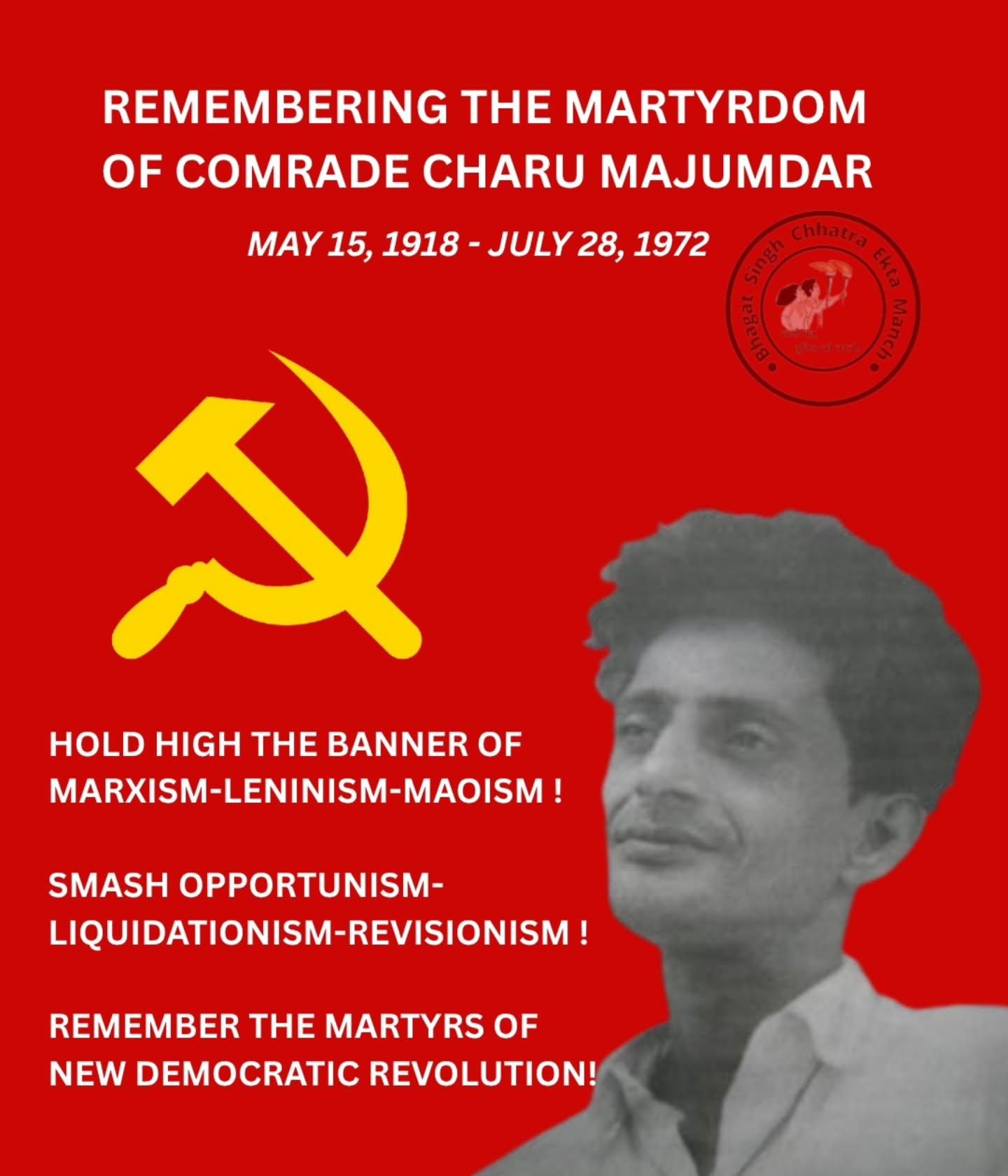 Comrade Charu Majumdar stands as one of
the greatest communist leaders of the world. At a time when revisionism
had reduced the communist movement in India to class collaboration, he
fearlessly upheld Marxism-Leninism-Maoism, and rekindled the path of
people’s war through the thunder of Naxalbari. He taught us that
revolution cannot be begged from the exploiting classes, nor won through
elections, but must be seized by the armed masses under the leadership
of a genuine communist party. His relentless struggle against
opportunism, his insistence on ideological purity, and his unwavering
confidence in the revolutionary potential of the poorest peasants
continue to illuminate the path of revolution in India. Though the
reactionary Indian state captured and murdered him in their custody,
they could never bury his politics. His blood nourished the
revolutionary movement, and his legacy lives on in every struggle that
dares to challenge imperialism, feudalism, and comprador bureaucratic
capitalism. To honour the martyrdom of Comrade Charu Majumdar is not to
worship an individual but to carry forward the revolutionary line for
which he lived, fought and gave his life.
Comrade Charu Majumdar stands as one of
the greatest communist leaders of the world. At a time when revisionism
had reduced the communist movement in India to class collaboration, he
fearlessly upheld Marxism-Leninism-Maoism, and rekindled the path of
people’s war through the thunder of Naxalbari. He taught us that
revolution cannot be begged from the exploiting classes, nor won through
elections, but must be seized by the armed masses under the leadership
of a genuine communist party. His relentless struggle against
opportunism, his insistence on ideological purity, and his unwavering
confidence in the revolutionary potential of the poorest peasants
continue to illuminate the path of revolution in India. Though the
reactionary Indian state captured and murdered him in their custody,
they could never bury his politics. His blood nourished the
revolutionary movement, and his legacy lives on in every struggle that
dares to challenge imperialism, feudalism, and comprador bureaucratic
capitalism. To honour the martyrdom of Comrade Charu Majumdar is not to
worship an individual but to carry forward the revolutionary line for
which he lived, fought and gave his life.
Charu Majumdar, and countless martyrs have laid down their lives in the service of the people. They struggled against attack by the reactionary forces, both within and external to the revolutionary movement. As we pay homage to martyrs, we need to also strengthen the struggle against Opportunism-Liquidationism-Revisionism, which is plaguing the revolutionary movement from within. Only by strengthening the fight against it, can we advance the cause of revolution.
EXPOSE THE OPPORTUNISM-LIQUIDATIONISM-REVISIONISM OF VISHWAVIJAY-SEEMA AZAD
The revolutionary movement in India has faced not only the direct external repression of the ruling state but also ideological and political attacks from within the revolutionary camp. History demonstrates that whenever revolutionary forces face periods of repression, setbacks and temporary retreats, the question of political line becomes decisive. It is precisely during such period that opportunist tendencies strongly emerge, seeking to replace revolutionary firmness with compromise, pessimism, and accomodation.
Today, the revolutionary movement is confronted with an intense assault by the reactionary ruling classes. The revolutionary masses and their organizations face military repression, arrests, surveillance and attempts at infiltration. In such circumstances, the task of revolutionaries is to strongly uphold revolutionary principles, and to deepen their understanding, strengthen, and learn from both successes and failures.
It is in this context that we must critically examine the political positions advanced by Vishwavijay and Seema Azad.
Their present political trajectory represents a serious departure from the revolutionary political line based on Marxism-Leninism-Maoism. Their positions, rather than contributing to the strengthening of revolutionary organisation, have created confusion regarding the necessity of revolutionary politics, organization, and methods of struggle.
The question before revolutionaries is therefore not one of personal loyalty or individual relationships. It is a question of political line. A person cannot be judged solely on the basis of their past contributions. Revolutionary history contains numerous examples of individuals who made important contributions at one stage of their political lives but later abandoned revolutionary principles. What matters is the political line that one upholds and practises today. Therefore, the argument that a person cannot be criticised because they have contributed to the revolutionary movement for many years is fundamentally flawed. Revolutionary politics demands continuous self-criticism, ideological struggle, and correction. Past contributions cannot provide permanent immunity from political criticism.
Under the pretext of combating an alleged “left deviation”, they propagated a right-opportunist line that rejected the necessity of maintaining a clandestine Party, belittled the centrality of protracted people’s war, and sought to replace revolutionary politics with legalism and reformism. They consistently attacked democratic centralism, encouraged organisational indiscipline, and promoted factional methods by secretly organizing an anti-Party clique while maintaining a deceptive appearance of unity. Their propagation of bourgeois-liberal conceptions, including the elevation of individualism over proletarian discipline and the promotion of political positions that go against communist morality, represented an ideological assault on Marxism-Leninism-Maoism. Their activities fostered confusion, weakened organisational cohesion, and has objectively served the interests of revisionism and the class enemy.
The history of the international communist movement teaches us that opportunism, and liquidationism often emerges most strongly during periods of political setbacks. The positions advanced by Vishwavijay and Seema Azad are same as those advanced by traitors like Sonu, Devji, and Balraj.
Although nominally Vishwavijay and Seema claim to be against these traitors, they are creating similar confusions, and engaging in liquidationist activities. Their content and class collaboration is the same, no matter how eloquently they can defend themself. When repression intensifies and revolutionary forces face temporary setbacks, some begin to question the very principles that guided the revolutionary movement.
Instead of analysing the objective conditions and identifying the causes of setbacks, they seek an easier path. Revolutionary organisation is portrayed as unnecessary. Discipline is presented as authoritarianism. Democratic centralism is reduced to bureaucratic control. Underground work is dismissed without a concrete analysis of the conditions that necessitate it. Such tendencies must be confronted through ideological and political struggle. The revolutionary movement cannot be built upon individual preferences, personal comfort, or petty-bourgeois aspirations. Revolution demands that individual interests be subordinated to the collective interests of the masses and the revolutionary cause.
They have portrayed democratic centralism as inherently oppressive and revolutionary discipline as mechanically imposed from above.
Such an understanding distorts the very essence of democratic centralism. Democratic centralism combines collective discussion and democratic participation with unity in action. Without democracy, centralism degenerates into bureaucratism. Without centralism, democracy can become fragmentation and individualism. The revolutionary organisation must therefore maintain the dialectical unity of both. Mao Zedong emphasised the relationship between democracy and centralism, freedom and discipline, as two aspects of a unified whole. Neither can be mechanically separated from the other.
A revolutionary organisation cannot function according to the individual wishes of its members. Nor can political differences be resolved through personal campaigns, social-media mobilisation, or the creation of competing lobbies. Differences must be addressed through principled ideological and political struggle.
The method of two-line struggle exists precisely because contradictions inevitably arise everywhere. The purpose of such struggle is to distinguish correct and incorrect political lines, strengthen unity on a principled basis, and advance revolutionary practice.
To abandon this method and instead personalise political differences is to weaken the revolutionary movement. The experience of the international communist movement demonstrates the dangers of liquidationism. Whenever revolutionary forces face repression, liquidationist tendencies emerge which argue that revolutionary structures must be abandoned, that the political line must be diluted and that revolutionary organisation should retreat into forms that are more acceptable to the existing system.
Such tendencies may present themselves as “realistic”, “practical”, or “modern”. But revolutionary politics cannot be determined by what is most comfortable or least risky. The question is not when the revolutionary work is difficult. The question is how revolutionaries respond to difficult conditions.
If repression increases, revolutionary forces must develop appropriate methods of functioning. If the enemy intensifies surveillance, revolutionaries must adapt their organisational methods. If the state attempts to destroy revolutionary structures, the answer cannot be simply to abandon those structures.
Some confusion has also led to the defending of Vishwavijay and Seema Azad by describing their political positions as merely the result of “confusion”. But political positions cannot be evaluated solely through the subjective intentions of individuals.
Confusion, when it genuinely exists, must be resolved through ideological struggle, criticism and self-criticism. A revolutionary who recognises an error must be willing to examine it and correct it. The real question, therefore, is not whether someone is “confused”. It is whether they are willing to engage in principled political struggle to overcome incorrect ideas. There is a fundamental difference between making an error and defending an incorrect political line. Revolutionary politics cannot be reduced to personalities, friendships or long-standing associations. The masses must learn to evaluate political positions on the basis of their class content and their practical consequences. We must also reject the tendency to transform political disagreements into personal disputes. The revolutionary movement must neither rely upon personality cults nor reduce political criticism to personal attacks. At the same time, political criticism cannot be silenced by accusing every critic of being motivated by personal hostility. The correct approach is to examine the political line.
What class interests does a particular position serve? Does it strengthen or weaken revolutionary organisation? Does it advance or retreat from the revolutionary objective?
The revolutionary movement is the application of Marxism-Leninism-Maoism to concrete conditions, constant ideological struggle, mass work, criticism and self-criticism, and a disciplined revolutionary organisation. We call upon all revolutionary people, students, workers, intellectuals, and democratic forces to study these political questions seriously and critically. Let us reject the politics of opportunism, liquidationism and revisionism, while defending the revolutionary principles of Marxism-Leninism-Maoism.
EXPOSE AND ISOLATE VISHWAVIJAY AND SEEMA AZAD!
FIGHT AGAINST OPPORTUNISM-LIQUIDATIONISM-REVISIONISM!
ADVANCE THE CAUSE OF NEW DEMOCRATIC REVOLUTION!

No comments:
Post a Comment