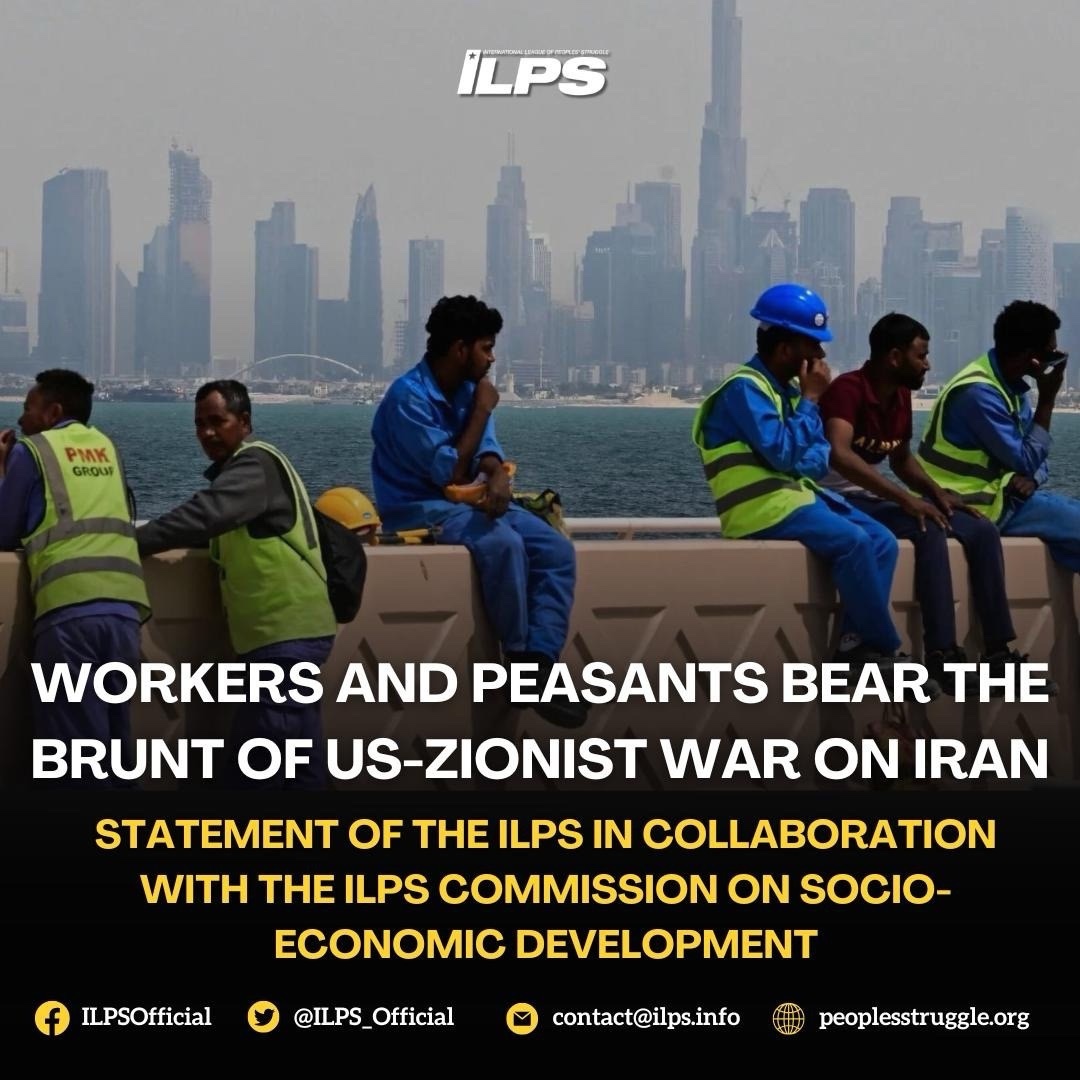
Statement of the ILPS in Collaboration with the ILPS Commission on Socio-Economic Development
The
US-Zionist attack on Iran is resulting in death and destruction inside
the country, and at the same time wreaking havoc on lives and
livelihoods of the working class and peasants, not only in Iran but
across Asia, the Pacific, and beyond. In Iran there has been carpet
bombing for days on end, as well as warfare in Lebanon and increased
massacres in Gaza and the West Bank. In this asymmetric war, Iran has
been retaliating by targeting US military bases and other assets in UAE,
Saudi Arabia, Bahrain, Kuwait and inside occupied Palestine. According
to Iranian official channels, nearly 1,400 people have been killed of
which more than 200 are children; 27 people have been killed in the Gulf
states from the attacks mounted by Iran.
On one hand,
the high-intensity active combat has direct impact on the social and
economic lives of the people in the war zones in Iran, and in wider West
Asia. On the other hand, Iran is limiting the passage of ships crossing
the Strait of Hormuz in retaliation against US-Zionist forces attacks
on its soil. Economic shocks of this action are being felt across the
world, but the severest impacts are borne by the basic masses,
especially in the Global South. Before the initiation of the Ramadan
War, about 20% of global oil and liquified gas passed through the
Strait, but after February 28, 2026, less than 100 ships have passed in
the 18 days of war, to date.
The impacts on migrant
workers, workers in home countries, peasants and various sectors of
society are immense. In UAE, migrant workers make up more than 90% of
the workforce. A majority are in low-skill and labor intensive,
low-paying jobs in construction, services or oil-related sectors, coming
from countries across Asia and Africa. Historically, migrant workers
are highly exploited and abused, working in slave-like conditions with
little space for demanding their rights.
In times of
war, where the higher-credentialed workers from imperialist nations are
fleeing the region, migrant workers have limited options. Many of them
are bread winners for their families, and have no choice but put their
lives at risk and continue working. A majority are in front line work
and remain on active duty. At the same time, governments such as
Philippines, Pakistan and Nepal among others are dependent on foreign
remittances, and make little effort to bring migrant workers home,
turning a blind eye to their safety and security. Up until now, migrant
workers from Pakistan, Philippines, Bangladesh are the ones who have
lost their lives in the war raging across West Asia.
In
countries outside the direct war zones, gig workers are the first to
face the impact of shortage of fuel its price hike and rise in fuel
prices. In India, based on shortage and/or high prices of LNG gas, major
platforms have temporarily closed restaurants; about 1 million workers
have lost their jobs just from two platforms. Workers have been
instructed to bring food from home. Similarly, in Pakistan, over 100
spinning mills, and 100s of ginning mills have been reportedly being
closed, which means thousands of workers have already lost jobs, and
many more millions will be in the same situation if the Strait of Hormuz
remains basically closed.
Agriculture sector is also
highly vulnerable across the Global South. Agro-chemical agriculture
production that was deliberately promoted by monopoly capital, is highly
dependent on fertilizers such as urea. One-third of globally traded
urea passes through the Strait of Hormuz. The Gulf countries are not
only producing urea but are also source of cheap LNG needed for urea
production. Crops such as wheat, maize and rice are highly dependent on
urea for high productivity, and sowing seasons are time bound. So,
peasants will be facing not only high cost of production, but also
potentially much lower yields if there is a shortage of urea in the
market. This will result in a vicious circle of much lower crop yields,
and elevated food prices. For the masses it will result in wide spread
hunger and malnutrition. In addition, there are thousands of fertilizer
production plants across Asia and Africa, and workers in these factors
also face job losses.
Dependency on fertilizers for
agriculture production will impact Global North as well. Australia
imports about 85% of its fertiliser needs, mainly from the Gulf states.
However, like Australia, countries in the North may have reserve stocks,
and the impact on agriculture production may not be immediate.
In
general, there is around 17-20% rise in fuel price in South Asia,
except for India where the hike is about 10-11%. However, in many
countries, petrol prices have gone up by 50% and 68%, such as in Vietnam
and Cambodia, respectively. In Nigeria, it is 35%, while for Puerto
Rico, it is almost 13%.
In countries like Australia,
the imperialist war against Iran has impacted people across; oil and
diesel prices have jumped by 32 – 39%. Hoarding is also happening which
further exacerbates the situation; in the US and Canada, petrol price
rise is about 20-28%.
Asia has been the most severely
impacted, and governments across Asia have taken different steps to
decrease fuel use which range from school closure, to online classes for
students, as well as mandatory work-from-home directives.
Increase
in fuel prices has had immediate impact across the board, as petrol is
an integral part of production and transportation. These price hikes
have a tremendously harsh impact on the working class that lives on
daily wages, or terribly low wages, but are being forced to pay for
higher prices for food, medicines, transport and energy.
Fisherfolk
are hit hard by fuel price hikes. Many fishers rely on liquified
petroleum gas (LPG) cylinders to power their boats. In the Philippines,
LPG prices are projected to rise by up to P30/kg, a ~P330 hike per 11kg
tank. In India, the government has reduced the size of cylinders from
14kg to 10kg, while prices have increased by Rs 60, equaling Rs 115 in
Mumbai and almost Rs 200 in the countryside.
Fisheries
in South Asia—spanning India, Sri Lanka, Bangladesh, Pakistan, and the
Maldives—are heavily dependent on diesel. From mechanized boats
operating in seas to small motorized boats used by artisanal fishers,
fuel is a critical input. Any fluctuation in global oil prices directly
affects the cost of fishing operations. In coastal regions such as
Maharashtra in India, fishers report that diesel prices have risen
steeply in recent weeks, making fishing trips economically unviable. A
single multi-day fishing expedition requires thousands of litres of
diesel. Even a modest increase per litre leads to a substantial rise in
total expenditure. For many fishers, the cost of fuel alone now
outweighs their expected earnings from the catch.
The
consequences of rising fuel costs are immediate and severe. Many fishing
boats are remaining docked because fishers cannot afford to venture
into the sea. This reduction in fishing activity not only affects
fishers but also disrupts the entire value chain, including fish
vendors, processors, transport workers, and exporters. Women, who play a
crucial role in post-harvest activities such as sorting, drying, and
selling fish, are also disproportionately affected as incomes decline.
In countries like India, Pakistan, Sri Lanka and Bangladesh, where
fisheries contribute significantly to food security and employment, the
crisis is even more acute. Reduced fishing activity leads to lower fish
availability in local markets, which in turn drives up prices and
affects poor consumers who rely on fish as a primary source of protein.
This has serious implications for nutrition, particularly for children
and vulnerable populations.
Another critical area
associated with petrochemicals is the pharmaceutical industry. India
provides a large volume of active ingredients for pharmaceutical
production, but is dependent on availability of flow of petrochemicals
from the Gulf region. The disruption in supply chains for generic
medicaments are going to impact countries in the North as well,
especially the US. It obtains approximately 47% of its prescription
medication from India. Higher prices of medication of course are going
to hit the poorest segments of the masses, as was seen clearly during
the Covid pandemic.
The hardship of the masses is
directly linked to the deliberate warmongering of the Zionist-US fascist
state that has held West Asia hostage to its desire for absolute
control over its oil and gas resources, and for other geo-political
interests. After waging war in Afghanistan, Iraq, Libya, Syria, Lebanon,
and the continuing genocide in Gaza, and decades of sanctions on Iran,
they have finally attacked Iran as well.
The workers,
peasants, fisherfolk all have already suffered immensely through
aggressive implementation of monopoly capital’s neoliberal policies,
with the assault on Iran only exacerbating their suffering. US
imperialism’s insatiable desire for waging wars, for initiating a new
era of occupation and colonialism has now been laid bare to the people.
Workers’
and other peoples’ organizations are already out in the streets holding
US-Zionist forces accountable for the new hardships faced by the
masses. The struggle for ending imperialism, for overturning occupation
and colonialism has taken fresh impetuous among the masses. This is the
time for the working class, the peasants and all marginalized classes to
unite, engage in class war, confront and take down monopoly capital for
a just and lasting peace.
Down, Down! Down with US imperialism!
No to Monopoly Control!
Workers United Will Never be Defeated.
Signed,
International
League of Peoples’ Struggle and the ILPS in Collaboration with the ILPS
Commission on Socio-Economic Development (Commission 2)



No comments:
Post a Comment