
Oman’s lesser-known communist separatist guerrilla. Today in 1965, Dhofar’s independence movement took up armed struggle.
The Masses Take Up Arms
It happened on 9 June, in the Wadi al-Kabir. A congress of fighters declared the opening of an armed struggle. It would consume the mountains of Dhofar for more than a decade. The Dhofar Liberation Front had been founded only months earlier. It was an offshoot of George Habash’s pan-Arab Movement of Arab Nationalists. Within a few years it would become one of the most ambitious revolutionary projects the Arabian Peninsula has ever seen. Then it would be erased almost entirely from the region’s official memory.
Feudal Tyranny Under British Patronage
The world the rebels rose against was, by any measure, archaic. Sultan Said bin Taimur ruled Muscat and Oman as a personal fief. Britain had propped him up financially and militarily since 1932. His regime banned schools for most subjects and prohibited paved roads and modern medicine. It policed daily life down to the absurd, forbidding football, sunglasses, and conversations longer than fifteen minutes. Dhofar, where the Sultan chose to reside, was governed not as a province but as private property. Its people, as the archival record shows, had effectively no rights at all.
From National Liberation to Scientific Socialism
The rebellion’s character shifted decisively after 1967. Britain withdrew from Aden, and the National Liberation Front won next door. The result was a Marxist state on Dhofar’s doorstep: the People’s Democratic Republic of Yemen. Sanctuary, weapons, and training followed.
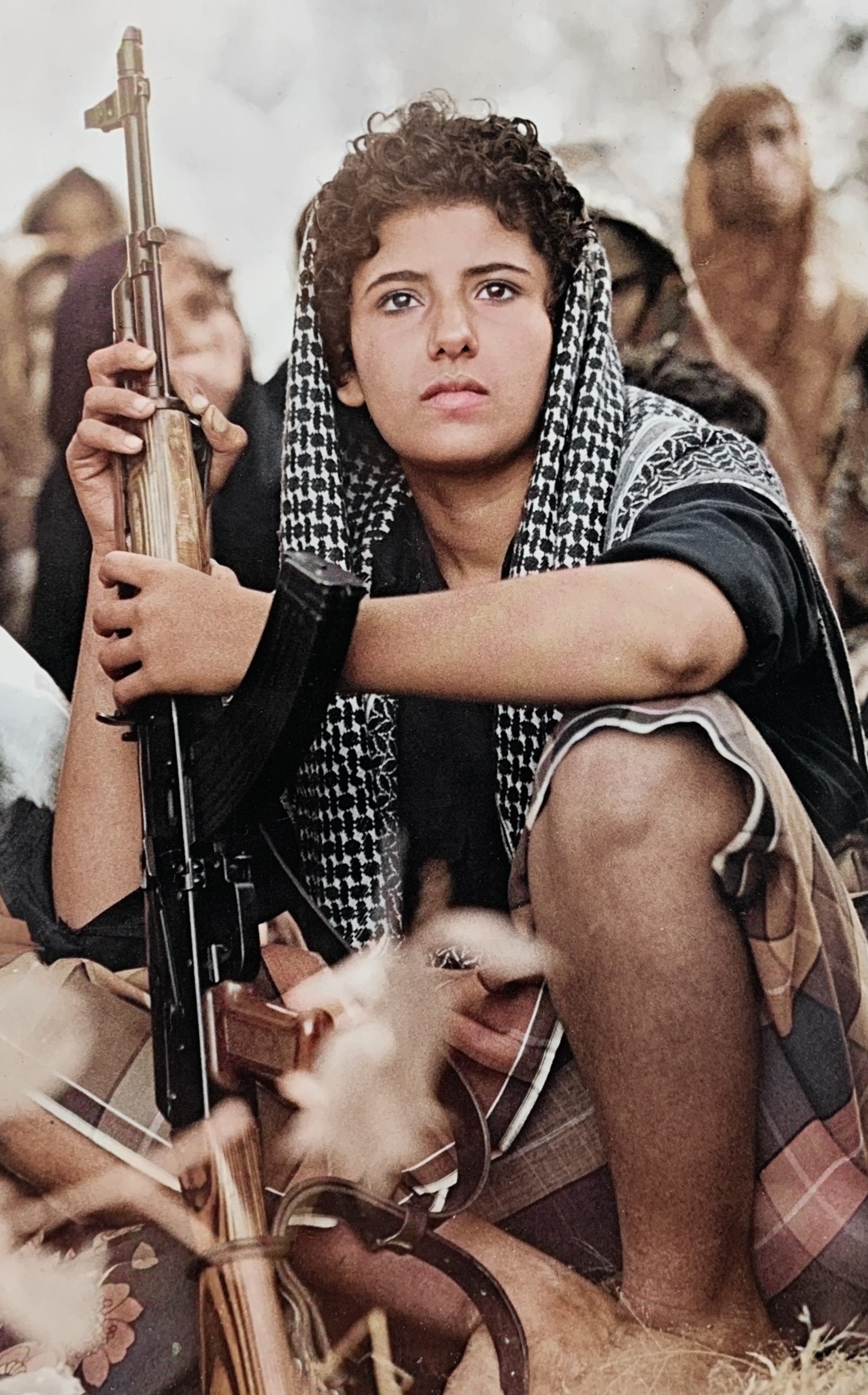
The turning point came at the Hamrin Conference of September 1968. There the movement renamed itself the Popular Front for the Liberation of Oman and the Arabian Gulf. It formally adopted Marxism-Leninism and a commitment to women’s liberation. It also embraced a wider vision. Its newspaper Sawt al-Thawra placed Dhofar within a tricontinental struggle spanning Asia, Africa, and Latin America.
Comrades Across Continents: The Maoist Line
China was central to this turn. The PFLOAG drew heavily on Maoist theory, and Beijing was quick to reciprocate. A peasant-based guerrilla force waging protracted struggle from a mountain base fit the Maoist model closely. That gave the Front strong credibility in Chinese eyes. China supplied weapons and military training, and Dhofari fighters were sent abroad — to China and elsewhere — for instruction in unconventional warfare. Beijing established an embassy in Aden, and South Yemen allowed its territory to be used to channel arms to the rebels. A new flow of Chinese and Soviet weaponry, together with better training, turned the PFLOAG’s armed wing into an effective fighting force; by 1969 it had overrun much of the Jebel. For Beijing there was also a Cold War calculation. Support for the PFLOAG acted as a counterweight to growing Soviet influence in the Indian Ocean. That Maoist phase proved relatively short, however. Chinese involvement waned after 1971, and Soviet aid expanded to fill the gap as the Sino-Soviet rivalry played out across the region.
Building the New Society in the Liberated Zones
What the PFLOAG built in its liberated zones is the part of the story most often left out. The Sultan had banned medicine and roads. The Front did the opposite. It poured resources into the infrastructure of a region the state had abandoned, opening schools and clinics. It also put into practice, however imperfectly, a programme of social transformation. That programme included one of the most radical experiments in women’s emancipation the Gulf had seen. For a time, the revolutionaries controlled almost the entire Jebel.
Women Hold Up Half the Sky
The commitment to women’s liberation, adopted at the same 1968 conference, was among the most striking features of the whole revolution. The PFLOAG held that the liberation of women was central to the success of the struggle. It would not arrive automatically, the Front argued, but only through a sustained fight against what it called the “objective backwardness” of society. This was a materialist analysis, drawn from Marxist thought and shaped by Maoism — including Mao’s famous line that women hold up half the sky. The PFLOAG recognised a double oppression: women were subordinated both as women in relation to men, and as workers in relation to the economic system.
The programme was not merely theoretical. Women fought in the People’s Liberation Army alongside men, and their political participation was treated as a measure of the revolution’s seriousness. In the liberated areas the Front moved against female circumcision and polygyny, and cut the bride price after failing to abolish it outright. Crucially, these campaigns were driven by women cadres themselves. The Bahraini militant Laila Fakhro (Huda Salem) pushed the PFLOAG to ban female circumcision and limit the bride price, and she also worked across political education, teaching, care work, and the Front’s media and foreign relations. In June 1970, with Abdel Rahman al-Nuaimi, she helped found the movement’s monthly magazine 9 Yunyu (9 June). An essay circulated by solidarity campaigners captured the stakes in the words of one Omani woman, who said she had suffered under four sultans: the sultan of Muscat, the tribal sheikh, the religious imam, and the family — her father, brother, and husband.
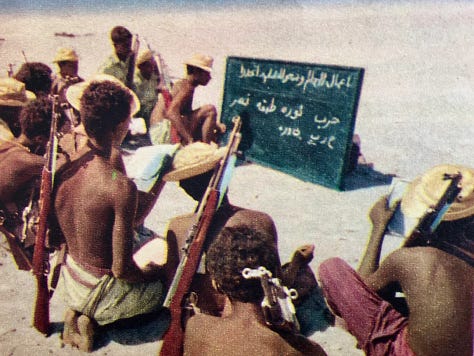
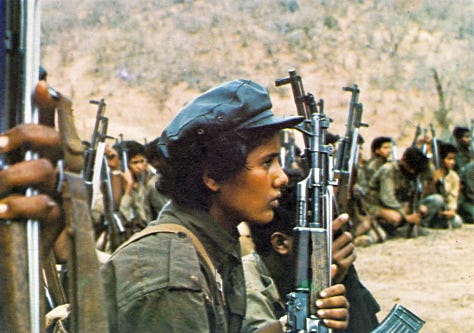
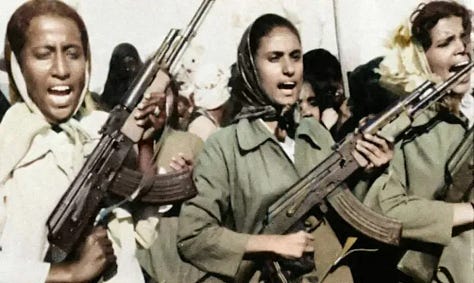
This radicalism drew outside attention. In 1971 the Lebanese filmmaker Heiny Srour travelled to Dhofar and filmed the women fighters who would appear in her 1974 documentary The Hour of Liberation Has Arrived. Srour, who described herself as a defeated feminist in Lebanon, was astonished to hear a PFLOAG representative raise the question of women’s oppression on his own initiative — naming not only imperialism and class, but fathers, husbands, and brothers.
The movement consciously placed its women within a wider revolutionary tradition. Its newspaper Sawt al-Thawra drew parallels with Vietnamese women fighters, documenting the arrests and mistreatment of women and girls by the British-backed regime alongside their internationalist activity. In June 1975 the revolutionaries founded the Omani Women’s Organisation, headed by Wafa Yasser, with its own programme to fight illiteracy and transform women’s social position. The following month the first official Omani women’s delegation — Nadia Khaled and Huda Muhad — travelled to a symposium organised by the Soviet Women’s Committee in Alma-Ata, in Soviet Kazakhstan. From there it went on to the Democratic Republic of Vietnam at the invitation of the Vietnamese Women’s Federation. Such links were material, not merely rhetorical. They showed that Dhofar was not an isolated revolt in a distant corner of the Gulf. It was a globally connected movement, and one that placed women’s political participation at its very centre.
Counter-Revolution: The British-Backed Coup
That this revolution was ultimately crushed owed less to the Sultan’s army than to the scale of foreign intervention arrayed against it. The first move came from within the palace. In July 1970, Said bin Taimur was deposed by his own son, Qaboos. The British military and the Foreign Office openly backed the coup. London had concluded that the old Sultan’s intransigence was making the insurgency worse. He was flown into exile and spent his last two years in a London hotel. Qaboos immediately launched the reforms his father had refused: development, amnesties, and the incorporation of Dhofar into Oman proper. They were explicitly designed to drain the rebellion of its popular base.
The Forces of Reaction
The reforms alone did not win the war. As the military analysts who have studied the campaign agree, the conflict was internationalised on a remarkable scale. From December 1973 the Shah of Iran dispatched troops to fight alongside the Sultan’s forces. He cited the security of the Strait of Hormuz. Iran eventually fielded an Imperial task force several thousand strong, complete with helicopters, paratroopers, and artillery. Jordanian special forces, Pakistani Baloch soldiers, Saudi money, and reportedly Israeli advisers joined the effort. Yet the coalition was still commanded almost entirely by British officers. A Times of London correspondent observed as much on the eve of victory. One Omani general told him bluntly that British withdrawal would be catastrophic.
The diplomatic ground shifted at the same time. After the 1975 Algiers Agreement, Iraq dropped its support for the Front. Sadat’s Egypt, courting the Gulf monarchies, did likewise. As external aid to Oman swelled, the rebels’ lifelines were severed one by one. In October 1975 the Sultan launched a final offensive, Operation Hadaf. It cut the PFLO, as the Front was by then known, off from its bases across the Yemeni border. After repeated setbacks, the remaining fighters retreated into the PDRY in 1976. The Dhofar Rebellion was declared defeated that same year.
A Forgotten Legacy
It remains one of the few Western-led counterinsurgencies counted a success in the postwar Middle East. It is also, not coincidentally, one of the most thoroughly forgotten. The men and women who fought for a different Arabia were not so much beaten by a sultan. They were overwhelmed by the combined weight of empires, monarchies, and a Cold War that had no intention of letting their experiment survive.
Yet defeat on the battlefield is not the same as irrelevance. For more than a decade, peasants and workers in one of the poorest corners of the Arabian Peninsula built schools and clinics where a sultan had banned both. They sent women to fight and to govern. They tied their mountain villages to the revolutionary currents of Vietnam, China, and the wider Third World. That this happened at all, in a region now synonymous with absolute monarchy and oil wealth, is a fact worth sitting with. The Gulf was not always destined to look the way it does today. Other futures were imagined, and for a time, fought for.
This article makes no claim to be a work of academic research or a scholarly paper. It is an introduction, drawn from the historians, theses, and journalism cited below, meant to bring a buried history back into view. The Dhofar Revolution deserves far more than a brief retelling. Its archives, its newspapers, and above all the testimony of those who lived it remain underexamined, scattered, and at risk of vanishing entirely. If these pages do anything, let it be to send the curious reader toward the sources, and to make the case that this forgotten chapter of the region’s past deserves to be studied far more seriously than it has been.
Sources
“The Dhofar Revolution: An Archival Analysis of the Conflict (1965–1976),” Journal of Islamic Thought and Civilization — https://journals.umt.edu.pk/index.php/JITC/article/download/6066/2955?inline=1
“The Dhofar Rebellion: Influence of External Powers on Counterinsurgency,” Naval Postgraduate School thesis (citing Geraint Hughes, “A ‘Model Campaign’ Reappraised”) — https://calhoun.nps.edu/server/api/core/bitstreams/453ddfa2-40d0-4d25-b476-7f22f2d5c2c9/content
“The Dhofar Rebellion,” DTIC archived study — https://apps.dtic.mil/sti/trecms/pdf/AD1184920.pdf
“Sawt al-Thawra: A Counterarchive of the Dhufar Revolution,” Marral Shamshiri, Revolutionary Papers — https://revolutionarypapers.org/teaching-tool/sawt-al-thawra/
Abdel Razzaq Takriti, Monsoon Revolution: Republicans, Sultans, and Empires in Oman 1965–1976 (Oxford University Press, 2013) — foundational scholarly history, cited throughout the Revolutionary Papers tool above
Geraint Hughes, “All the Shah’s Men: The Imperial Iranian Brigade Group in the Dhofar War,” Defence-in-Depth (King’s College London) — https://defenceindepth.co/2016/06/06/all-the-shahs-men-the-imperial-iranian-brigade-group-in-the-dhofar-war/
“The Dhofar War and the Myth of ‘Localized’ Conflicts,” RealClearDefense — https://www.realcleardefense.com/articles/2018/01/12/the_dhofar_war_and_the_myth_of_localized_conflicts_112890.html
“Oman: How the Shah of Iran Saved the Regime,” Orient XXI (citing The Times of London, 1976) — https://orientxxi.info/magazine/oman-how-the-shah-of-iran-saved-the-regime,3681
“Remembering the Shah’s Iran – Iran War Briefing #9,” Counterfire — https://www.counterfire.org/article/remembering-the-shahs-iran/
“China–Oman Cooperation in the Age of the Belt and Road Initiative,” Manara Magazine (on Chinese moral, financial, and military aid to the Dhofar rebels) — https://manaramagazine.org/2019/05/china-oman-belt-and-road-initiative/
“China’s Rising in the Gulf and Relations with Oman,” ResearchGate (citing Jonathan Fulton, “China’s Relations with Oman”) — https://www.researchgate.net/publication/347520694_China’s_Rising_in_the_Gulf_and_Relations_with_Oman

No comments:
Post a Comment